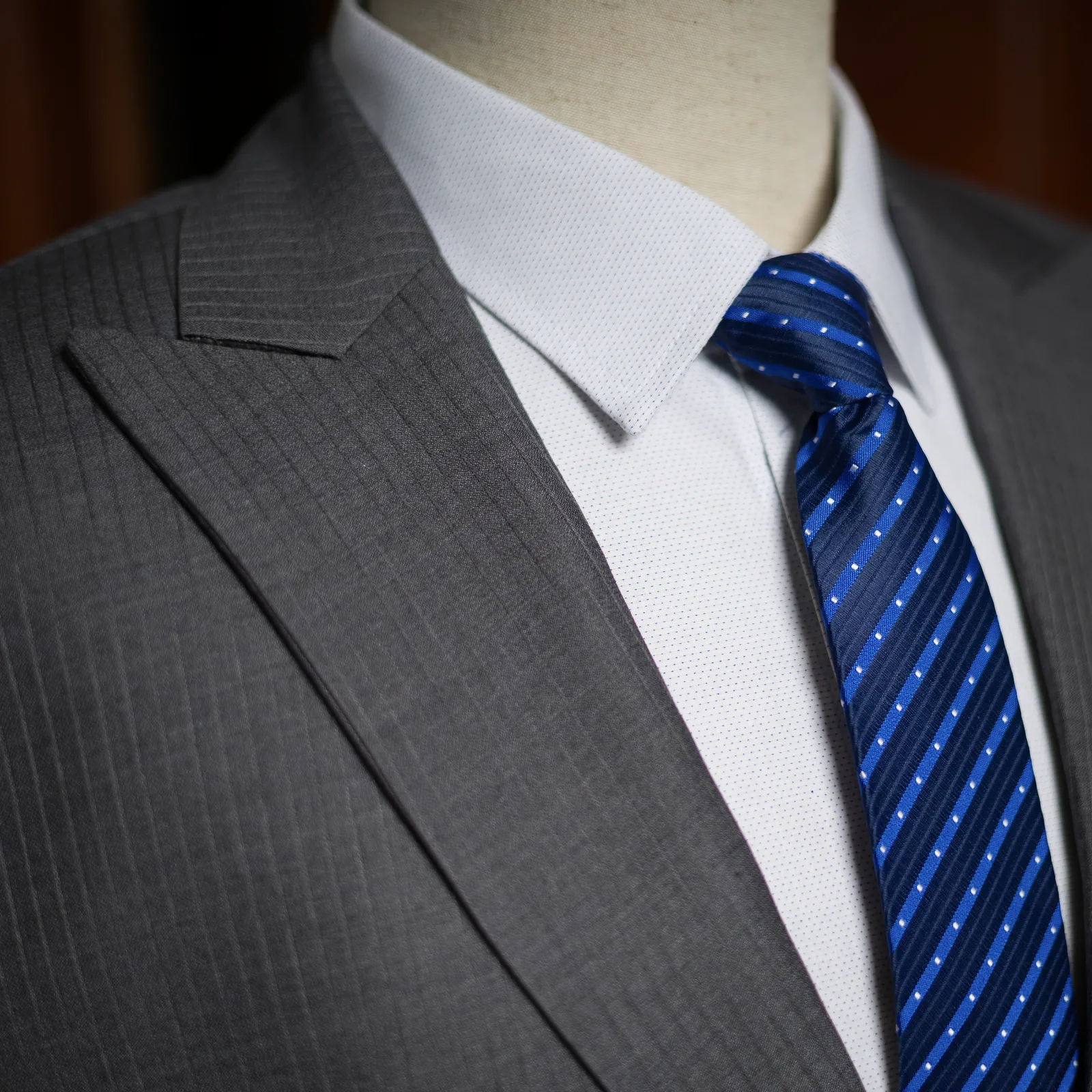
There is a moment, roughly thirty minutes into Alfred Hitchcock's 1959 film North by Northwest, where Cary Grant steps off a bus onto a flat, sun-bleached stretch of road in the middle of nowhere — a cornfield, an empty sky, dust rising in the distance — and the wrongness of his situation is underscored entirely by his appearance. He is impeccably dressed. The suit is grey, the cut is perfect, and he moves in it as though it were a second skin. Crop duster or not, he looks like a man in complete control of something. That suit has fascinated me since I was old enough to notice clothes, and when I found myself planning a week in Hoi An with time to spare, the idea that had been quietly sitting at the back of my mind finally felt feasible. I was going to have it made.
Why This Is the Greatest Suit in Cinema History
The suit Grant wears throughout North by Northwest — designed by Hitchcock's longtime collaborator and reportedly chosen to complement Grant's particular physicality — is a study in what a suit can communicate when it is doing everything right. It is a grey glen plaid in a medium weight wool, cut as a slim two-button single-breasted jacket with natural shoulders, a clean chest, and a subtle waist suppression that emphasises Grant's proportion without exaggerating it. The trousers are slightly tapered with a single break. There is a dual vent at the back of the jacket. The lapels are notched, at a moderate width that reads as neither aggressive nor timid. Nothing about it draws attention to itself. Everything about it is exactly right.
What makes it remarkable — and what students of tailoring have analysed in detail for decades — is how it performs under stress. The suit survives a plane crash scene, a dramatic physical confrontation at Mount Rushmore, and hours of running, hiding, and improvising, and throughout all of this it maintains its shape. The chest never buckles. The shoulders never shift. This is partly cinematic magic, but it is also a function of how a properly constructed suit, with good canvas and quality wool, actually behaves on a body over time. It is a demonstration of what the garment is capable of when it is made correctly.
There is also the matter of colour. The grey is not a safe medium grey but a complex tone with a bluish cast in certain lights and a warmth in others — exactly what glen plaid achieves at its best. Against Grant's colouring and the film's careful palette, it is neither conspicuous nor invisible. It is simply correct. I had been searching for a fabric that came close to this for several years before I finally found something serviceable in a sample book at Be Li Tailor.
Breaking Down the Suit: Fabric, Cut, and Construction Details
Before any commission, it is worth being precise about what you're asking for. I spent time pausing and zooming through the film, noting details on paper, and cross-referencing with the substantial body of writing that exists about this specific suit. The key specifications, as I understood them:
- Fabric: Grey glen plaid (also called Prince of Wales check) in a medium-weight pure wool, approximately 280 to 300 grams per metre
- Jacket: Slim two-button, single-breasted, notched lapel at moderate width
- Shoulder: Natural (soft) shoulder, no padding, no roping
- Chest: Flat, no excess fabric, with light waist suppression
- Back: Dual vent, approximately 20 to 22 centimetres
- Finishing: Pick-stitching on lapel edge and pocket edges — the fine hand-stitching detail visible as a thin parallel line along the edge of the lapel
- Trousers: Flat-front, slightly tapered through the thigh and leg, single break, no cuffs
- Lining: Full, in a plain mid-grey
The pick-stitching is a detail that many people overlook in screen grabs, but it is visible in high-quality stills and is one of the markers of a properly constructed jacket rather than a machine-finished one. It is also one of the details that distinguishes a careful commission from a quick reproduction, and it was something I felt strongly about including.
Why Hoi An Is the Right Place to Recreate It
The case for having a cinematic suit recreation made in Hoi An is stronger than it might initially seem. The tailoring tradition here is built on precision and individual attention — the same skills that make a well-documented reference suit achievable are the skills that make any bespoke garment successful. What you need is a tailor who can read a technical brief, source an appropriate fabric, and execute to a high standard. The bespoke menswear at Be Li Tailor is built around exactly this kind of work — specific commissions with detailed requirements, made by tailors who have been doing this for decades.
The cost argument is also real. Having a suit of this specification made in London — natural shoulder, pick-stitching, full canvas, pure wool — would cost somewhere between £1,200 and £2,500 depending on the house. In Hoi An, with an appropriate imported wool fabric, the same specification came to $340. That is not a cheap suit made to look like an expensive one. It is an expensive suit made in a country where the labour costs are dramatically lower, by hands that are no less skilled for being in Vietnam rather than Mayfair.
I spent time, before committing, looking at completed commissions from Be Li Tailor and discussing the specification in detail. The response was knowledgeable and specific — the tailor understood glen plaid matching, understood what natural shoulder construction meant and why it differed from a padded shoulder, and had a clear view on which fabric in stock came closest to the weight and scale of check I was describing. That conversation gave me confidence that the commission was feasible.
Working with Be Li Tailor on the Specification
I arrived for the consultation with a printed set of reference images, including several high-resolution stills from the film and a diagram I had sketched showing the construction details I wanted. This level of preparation is, I suspect, unusual, but it was met without any sign of surprise. The tailor went through my reference images methodically, asked several clarifying questions — jacket button stance, preferred trouser rise, whether I wanted the lapel buttonhole to be functional — and made notes that were considerably more detailed than anything I'd seen at a high-street tailor in my home country.
The pick-stitching was discussed specifically. Hand pick-stitching — where each stitch is placed individually along the edge — takes more time than machine stitching and adds to the cost, but it is the detail that most directly connects the finished garment to the reference. The tailor's view was that it was achievable and that it was worth doing if I was committing to the other elements of the brief. That recommendation felt like the response of someone who cared about the outcome rather than someone managing my expectations downward to make the job easier.
We also discussed the glen plaid scale. The check on the original Grant suit is relatively fine — a smaller repeat than some glen plaids, which gives it a more restrained appearance that reads as texture at a distance rather than obvious pattern. Getting the check matching right at the jacket's front seams and patch pockets was something the tailor raised proactively, noting that it would require careful cutting and a small amount of additional fabric. This is the kind of detail that separates a tailor who is thinking about the finished garment from one who is thinking about the fastest route through the commission.
Fabric Selection: Getting the Grey Glen Plaid Right
Finding the right fabric was the part of the process I was most uncertain about. Glen plaid in a genuinely film-accurate grey — not charcoal, not mid-grey, but that particular complex tone with its slight blue cast — is not the most commonly stocked pattern in Hoi An's fabric suppliers. The studio had several glen plaids in their fabric room, and after handling all of them carefully under different lighting conditions, I settled on an Italian wool blend that came closest to the reference. It was not an exact match — achieving that would require commissioning bespoke fabric from a mill, which is beyond the scope of most visits — but it was close enough in tone and weight to serve the purpose well.
The check scale was slightly larger than the original, which is an acceptable variation. What mattered more was the colour and the quality of the wool. The fabric I chose had a tight, even weave with good drape and enough body to hold the natural shoulder construction without sagging. At 285 grams per metre it was appropriately weighted for a suit that would be worn in temperate rather than tropical conditions — I had been clear with the tailor that this was for cooler weather wear, which shaped the fabric recommendation meaningfully. If you're planning a similar commission, it's worth being equally specific about where and when you'll be wearing the finished garment.
The Finished Suit: How Close Did We Get?
The honest answer is: closer than I expected, and close enough that people who know the reference recognise it immediately. The shoulders sit as they should — soft and clean, without the slightly squared look that padding produces. The chest lies flat. The pick-stitching is there on the lapel edge and pocket edges, hand-done, the stitches even and fine. The dual vent falls correctly. The trousers hang with the right break, flat-fronted and tapered without being narrow.
Is it identical to the suit Grant wore? No. The fabric is not exactly the same. My proportions are not Grant's — I am three inches shorter and slightly broader across the back, which required adjustments that move the silhouette away from the original. A faithful recreation is always an interpretation: you are transposing a specific design onto a different body and a different time, using materials that approximate but cannot exactly reproduce the original. What you end up with, when the work is done well, is a suit that is faithful in spirit and precise in execution — one that captures what made the original great and makes it work for the person wearing it.
I have worn this suit more than any other I own. That is, ultimately, the only review that matters.
Commission Your Own Cinematic Suit
Be Li Tailor is at 635 Hai Bà Trưng, Hội An, open daily 8am–9pm. If you have a reference garment — whether it's a film costume, a heritage photograph, or a suit you've always admired — bring it to us or book a consultation and we'll work out how to make it yours.