One of the most disorienting moments in any Hoi An tailoring experience is receiving the quote. You sit down with a tailor, describe what you want, choose a fabric, and then a figure appears — sometimes scrawled on a notepad, sometimes delivered verbally with a degree of confidence that makes it hard to know whether it is fixed or an opening position. If you are new to bespoke tailoring, you have almost no frame of reference for whether that number is fair, high, or suspiciously low.
This guide is designed to give you that frame of reference. I am going to break down exactly what goes into a tailor's quote in Hoi An — what the different line items represent, why the same garment can cost $80 at one shop and $280 at another, and what you should expect to pay for a range of common commissions. By the time you sit down for a consultation, you will know enough to ask the right questions and recognise a fair deal when you see one.
Why Tailor Quotes in Hoi An Vary So Widely
The price range for a made-to-measure suit in Hoi An spans roughly $80 to $400, depending on the studio and fabric selection. That is a fivefold difference for what is nominally the same garment. Understanding why requires understanding the four major cost drivers in any tailored garment: fabric quality, labour cost, construction method, and overhead.
Labour cost in Vietnam is significantly lower than in Europe, Japan, or the United States — this is why Hoi An tailoring represents such good value in absolute terms. But labour cost is not uniform across studios. A shop employing experienced senior tailors with fifteen or twenty years of practice charges more for their time than one relying on trainees or piece-workers. The skill differential is real and shows up in the finished garment.
Construction method is the other major variable. A fused jacket — one where the interfacing is glued to the outer fabric under heat — is much faster to produce than a canvassed jacket, where the interfacing is stitched by hand and floats freely within the garment. Both jackets can look identical hanging on a rail. Over time, the canvassed jacket conforms to the wearer's body and improves with age; the fused jacket tends to bubble and delaminate. The canvassed version costs more because it requires more skilled labour, and any honest quote should reflect that difference explicitly.
Breaking Down a Quote: What Each Cost Covers
A well-structured quote from a Hoi An tailor should be itemised into at least four components: fabric, lining (where applicable), making charge, and any additional construction options. If a tailor gives you a single number without explanation, it is entirely reasonable to ask how that figure breaks down. Any serious studio will have a clear answer.
The fabric cost covers the cloth itself, typically priced per metre with an indication of how many metres are required for the garment. For a two-piece suit, you are looking at approximately 3.5 to 4 metres of outer cloth and 2 to 2.5 metres of lining. For a dress shirt, 1.5 to 2 metres. The fabric cost will vary enormously based on the mill and fibre — more on this below.
The making charge covers pattern drafting, cutting, construction, and finishing. This is where the tailor's skill and labour time is captured. A making charge of $60 to $80 for a two-piece suit is at the low end of what honest work costs; $120 to $180 is mid-range for a quality studio; anything above that is either a premium establishment or a studio catering primarily to a luxury-seeking clientele. The making charge should include all fitting sessions — if a studio quotes a making charge and then wants to add a "fitting fee," be cautious.
The lining and interlining costs are sometimes folded into the making charge and sometimes separated. A quality lining fabric — silk or Bemberg (a rayon-based fabric that behaves like silk) — adds $15 to $30 to a jacket's cost over a basic polyester lining. It is worth paying for.
Fabric Cost: The Biggest Variable in Any Quote
Fabric is where the widest variation occurs and where the most dishonesty lurks. High-quality wool from Italian mills like Vitale Barberis Canonico or Reda typically costs $25 to $50 per metre at wholesale. English woolens from Dormeuil or Holland & Sherry are similar. Vietnamese-spun linens and cottons are considerably cheaper — $5 to $15 per metre — but are entirely appropriate for casual and resort wear. Good Vietnamese silk runs $12 to $25 per metre depending on weight and weave.
The problem is that synthetic fibres — polyester, polyester-viscose blends, and various branded "micro-fibres" — can look very similar to natural cloth on the shelf and are priced at $3 to $8 per metre. A shop buying cheap synthetic at $4 per metre and representing it as Italian wool at $35 per metre is pocketing a significant margin while delivering an inferior product. The garment will look reasonable initially but will not breathe, will not drape the same way, and will deteriorate far more quickly than the natural fibre equivalent.
The most reliable protection is to ask for the fabric's origin and content explicitly, and to request a swatch from the specific bolt that will be used for your garment. Burn a thread from the swatch: natural fibres burn slowly and smell organic; synthetics melt, bead, and smell like burning plastic. If a tailor is unwilling to let you test a swatch, that is a clear warning sign. Be Li Tailor's menswear range sources exclusively from natural-fibre suppliers, and we are always happy to show the provenance of our cloth before a single cut is made.
Construction Details That Affect the Final Price
Beyond fabric and making charge, certain construction decisions add meaningfully to the cost of a garment and are worth understanding before you finalise your order. For jackets and suits, the key decision is canvas vs. fuse. A full canvas construction uses a layer of woven horsehair canvas that runs through the chest and lapels, hand-stitched in place so it moves independently of the outer fabric. It takes three to four times longer to make than a fused chest and adds roughly $40 to $80 to the making charge. It is worth it for any garment you intend to wear regularly for more than two years.
A half canvas construction — canvassed through the chest and lapel only, with a fused skirt — is a reasonable compromise that most good tailors offer. It delivers most of the drape and longevity benefits at a lower premium than full canvas. Fully fused construction is the budget option and is entirely acceptable for occasional-wear pieces or garments you plan to leave behind at the end of a trip.
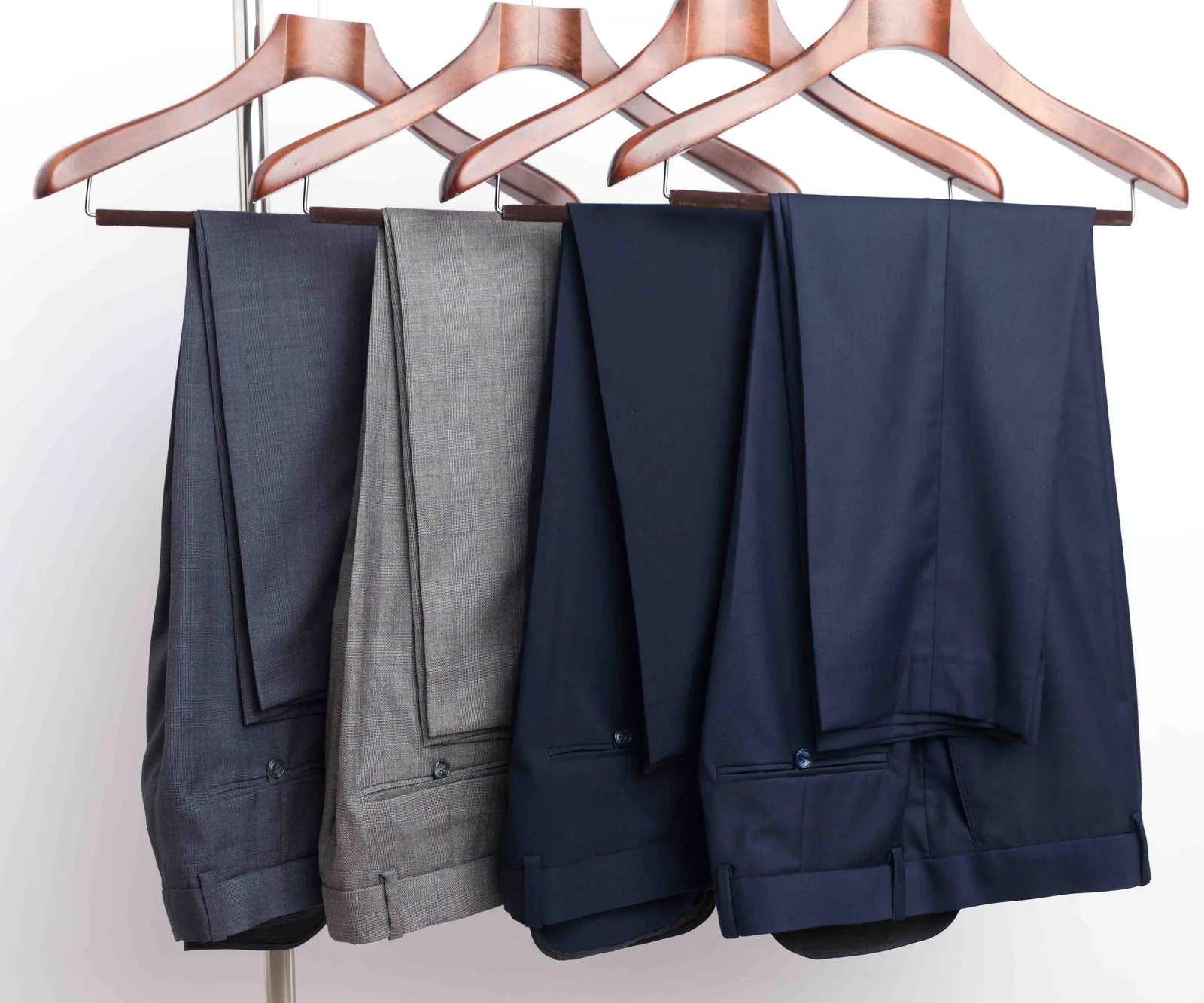
For trousers, the detail that affects both cost and wearability most is the waistband construction. A curtain waistband — where the trouser fabric simply folds over and is stitched down — is inexpensive but uncomfortable over long periods. A proper fitted waistband with interlining and a separate facing adds $8 to $15 to the cost of a pair of trousers and makes a significant difference to how they feel and sit over the course of a day.
What a Fair Quote for a Suit, Dress, or Shirt Looks Like
To give you a working reference, here are the price ranges I would consider fair for quality work at a reputable Hoi An studio in mid-2026. These assume natural fibre fabrics and honest making charges — not the cheapest possible option, and not inflated for luxury positioning.
- Two-piece suit in wool or wool blend — $200 to $320 with full canvas or half canvas construction
- Dress shirt in 100% cotton — $45 to $75 depending on collar style and cuff construction
- Linen trousers — $55 to $90
- Women's tailored blazer — $120 to $200
- Women's silk dress — $90 to $180 depending on complexity of cut and embellishment
- Ao Dai (traditional Vietnamese dress) — $80 to $160 in silk
If a quote is significantly below these ranges, it is worth asking which corners are being cut — on fabric, on construction, or on time. A $90 two-piece suit is not impossible in Hoi An, but it will almost certainly involve synthetic fabric and fused construction, and the fitting process will be minimal. That may be entirely acceptable for your purposes; just know what you are paying for.
How Be Li Tailor Quotes Transparently
At Be Li Tailor, we provide written, itemised quotes for every commission before any deposit changes hands. The quote separates fabric cost, lining cost, making charge, and any construction upgrades so you can see exactly what each element contributes to the total. We do not inflate one line item to absorb a discount on another — the numbers represent what the work actually costs.
We also take time during the consultation to explain the construction options and what they mean in practice. If you are commissioning a suit that you plan to wear twice a year, we may suggest that a quality fused construction is the more sensible investment for your needs. If you are building a workhorse garment that will travel with you for the next decade, we will recommend canvas and explain why it is worth the additional cost.
The goal is for you to leave the consultation with a clear understanding of what you are commissioning, what it will cost, and why. Contact us in advance of your visit if you want to discuss a specific commission and get a ballpark figure before you arrive — we are happy to provide indicative quotes based on a description and can give firmer numbers once we have met in person and you have chosen your cloth.
Get a Clear Quote Before You Commit
Be Li Tailor is at 635 Hai Bà Trưng, Hội An, open daily 8am–9pm. We give itemised, transparent quotes for everything we make — contact us before your visit or walk in and ask for a quote on any garment. No pressure, no hidden costs.