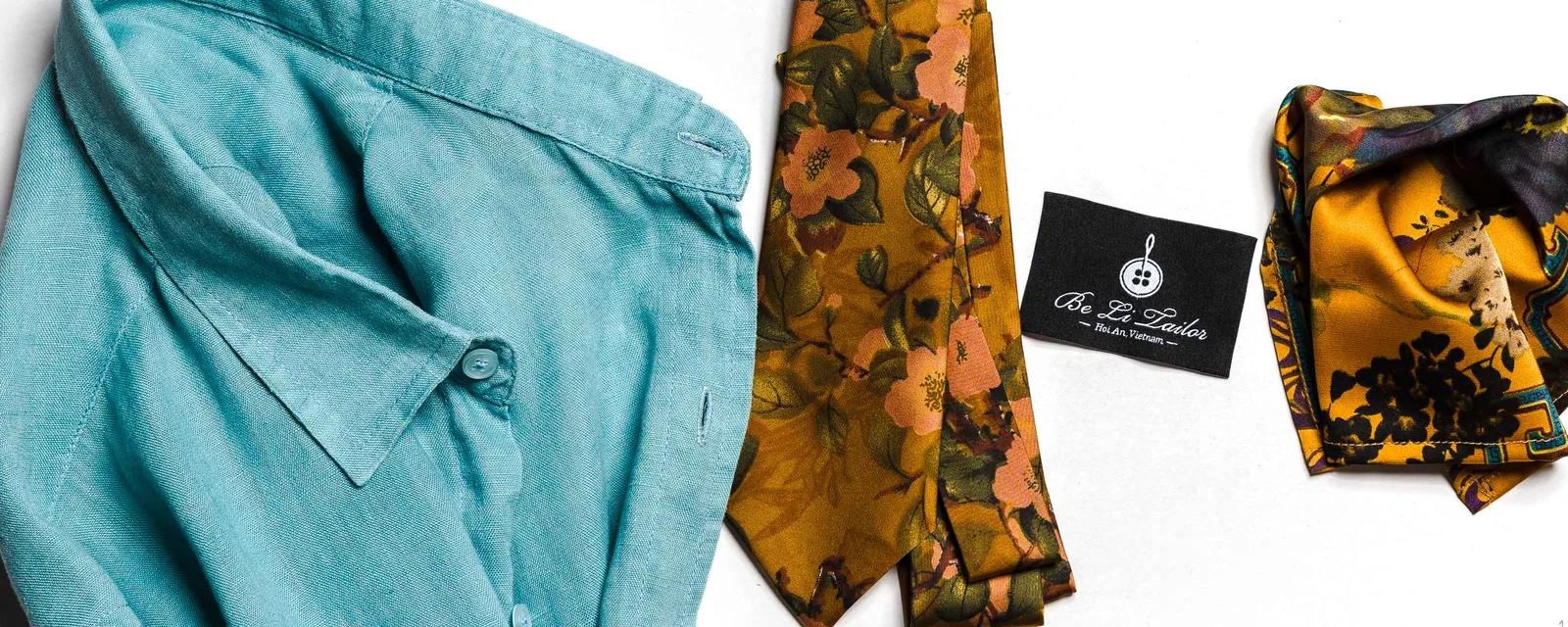
Most people who visit Hội An's tailoring quarter come for the obvious things: a suit, a dress, a linen blazer or two. They leave with those things, and they're thrilled. But somewhere on the flight home, a small realisation tends to settle in — the suit is perfect, the jacket is extraordinary, and then there's the polyester tie they bought at the airport three years ago sitting around their neck at their next important occasion. The whole effect is undermined by one item they never thought to commission.
Hội An's tailors can make a remarkable range of accessories, and most visitors simply don't know to ask. It's one of those things that nobody puts on a sign because the tailors themselves are too modest to push it, and travellers are too focused on the suit to think about what will go with it. This guide is an attempt to fix that gap — to explain what's available, what it costs, and how a few well-chosen accessories can transform a bespoke wardrobe from very good into something genuinely complete.
What Custom Accessories Can Be Made in Hoi An
The range is wider than most people expect. The obvious category is silk accessories — ties, bow ties, pocket squares, and scarves — but beyond that, leather goods are also available from a number of specialist workshops in and around the Ancient Town. Custom bags, belts, wallets, card holders, and even simple footwear can all be made to order. Some of Hội An's tailors have close relationships with local leather workers and can coordinate an entire accessory order alongside a clothing commission.
Fabric accessories extend further than silk: cotton pocket squares, linen scarves, cashmere-blend wraps, even fabric-covered cufflinks using remnants from your suit cloth. These last items in particular are something I find quietly magical — a pocket square cut from the same bolt of fabric as your jacket, so the colours are an exact match rather than an approximation. It's the kind of detail that nobody else will necessarily notice, but that you'll know is there.
The key question to ask your tailor is what they can coordinate in-house versus what they need to outsource. A shop with direct relationships with silk weavers and leather workers will generally produce better results than one acting purely as a middleman. At Be Li Tailor, we have established suppliers for our silk accessories and work with trusted leather craftspeople for belts and bags — which means we can vouch for the quality of materials and the standard of the finished work.
Ties, Pocket Squares, and Silk Accessories
A custom silk tie is one of the best-value bespoke items you can commission in Hội An. The cost is typically in the $20–45 range depending on the quality of the silk and the complexity of the pattern, and the quality of hand-rolled edge finish on a good custom tie is noticeably superior to most department-store ties at several times the price. The width, length, and lining can all be specified — important details if you're tall, if you have strong preferences about blade width, or if you want a tie that can be tied in a particular knot without excess bulk.
Pocket squares can be made from silk, linen, or cotton, and unlike a tie they're genuinely simple to produce — which means turnaround can sometimes be as fast as a day. The options include hand-rolled edges in matching or contrasting thread, which adds a level of finish you simply don't see on machine-hemmed squares. A set of three or four pocket squares — one white linen for formality, one silk in a pattern that picks up a colour from your suit, one cotton for more casual wear — covers most wardrobe needs and costs a fraction of what you'd pay for equivalent quality at home.
For women, silk scarves and wraps made in Hội An can be exceptional. The local silk industry has centuries of history in this region of Vietnam, and a scarf made from Vietnamese silk — light, lustrous, and with a hand-feel that synthetic substitutes simply don't replicate — is one of the more enduring souvenirs you can bring home. Our womenswear commissions often include a scarf or wrap as a finishing piece alongside a dress or trouser suit, and the combination tends to produce results that feel genuinely cohesive rather than assembled from different shopping trips.
Belts, Bags, and Leather Goods: What's Available
Custom leather belts are one of those accessories that people consistently underestimate until they have one. A belt made to your actual waist measurement — rather than a standard size that falls between two holes — sits differently. A proper dress belt in bridle leather or full-grain cowhide, made with a solid brass or silver buckle of your choice, will outlast most other accessories you own and develops a patina that only improves over years of use. Expect to pay between $40 and $90 depending on leather grade and hardware, with a turnaround of two to three days.
Bags are more complex and variable in quality, so it pays to look carefully at the leather and stitching before committing. A well-made leather tote or briefcase from one of Hội An's better workshops — using full-grain rather than split-grain leather, with saddle-stitched rather than machine-sewn seams — can be a genuinely excellent product at around $80–180. Look at how the seams are finished on the inside as well as the outside, check that the stitching is even and tight, and examine the hardware for any signs of cheap plating. The quality varies considerably between workshops, so asking for a referral from your tailor is worthwhile.
Wallets, card holders, and passport covers are smaller and less expensive, typically in the $15–35 range, and the risks are proportionally lower. These make excellent additions to an accessories order and travel well as gifts. A slim card holder in vegetable-tanned leather, with your initials hand-tooled or embossed on the front, takes all of two hours to produce and costs almost nothing by the standards of most boutique leather goods brands.
How Accessories Tie a Bespoke Wardrobe Together
There's a styling principle that's easy to state but harder to put into practice: the best-dressed people don't look like they tried very hard. The reason their outfits appear effortless is usually that the component parts were chosen carefully to work together at a level below conscious awareness. Colours repeat. Textures complement. The weight of a pocket square echoes the weight of a lapel. None of these things shout — they just harmonise, and the overall impression is one of someone who is simply, naturally, well put together.
Custom accessories make this harmony much easier to achieve than picking up pieces from different places at different times. When your tie is cut from silk that was chosen in conversation with the same tailor who selected your suit cloth, and your pocket square is hemmed in a thread that picks up the stripe in your shirt, the result is a considered whole rather than a lucky accident. You're not trying to match things you already own — you're designing them to work together from the start.
This is especially true for suits commissioned for specific occasions. A wedding suit, an important interview, a significant anniversary dinner — these are moments where the overall image matters. Adding a custom tie or a matching pocket square to a suit order costs relatively little and adds something you simply can't replicate later by shopping in a hurry.
What I Ordered Alongside My Suit at Be Li Tailor
When I commissioned my most recent suit here — a charcoal wool with a fine chalk stripe, cut for business wear — I added a pocket square from the same roll of cloth before the excess was put away. The tailor hand-rolled the edges in a white silk thread that picks up the chalk stripe. It took an extra day and cost almost nothing, but every time I wear the suit I'm aware that the pocket square sitting in the breast pocket belongs there in a way that nothing else I own quite does.
I also ordered a woven silk tie in a deep burgundy that was chosen by holding it against the suit fabric in natural light until the combination felt right. This is one of the things you can only do when you're in the same room as your materials — online shopping for accessories to match a suit you haven't worn yet is an educated guess at best. The tie cost around $35 and came with hand-rolled edges and a proper interlining. The equivalent quality at home would cost considerably more.
The other thing I added was a leather belt — simple black bridle leather, 30mm wide, with a single-prong silver buckle. It was made to my exact waist measurement. The previous belt I'd been wearing had a small gap between the nearest hole and the ideal fit. This one sits exactly where it should, every time. That sounds trivial until you've experienced it, at which point it seems obviously worth the $55 I paid for it. If you're commissioning a suit with us, ask about adding a belt to the order — the leather worker we use is excellent.
The Finishing Touches That Make a Real Difference
There are a few accessory items that consistently surprise people with the difference they make. Cufflinks made from fabric remnants — I mentioned these earlier — are one. Another is a hand-stitched collar stay: a small piece of metal sewn inside the collar points of a custom shirt to keep them flat without the need for external stays. It's invisible and it works perfectly. Many off-the-rack shirts have no collar stays at all, which is why the collar curls up by mid-afternoon.
A well-made tie bar or tie clip, positioned correctly at the fourth shirt button, keeps a tie in place throughout the day without swinging away from the shirt and drawing attention. These can be made locally or sourced from hardware suppliers in Hội An for very modest amounts. A boutonniere hole — a small worked buttonhole on the left lapel of a jacket — is another finishing detail that most people overlook until they want to wear a flower at a wedding and realise their jacket has no proper place for one. It takes the tailor five minutes to add and costs almost nothing.
The lesson I keep coming back to is that accessories are where a bespoke wardrobe earns the word bespoke. Getting the suit right is the major achievement. But the accessories are what transforms it from a very good garment into an outfit — and in Hội An, with access to silk weavers and leather craftspeople within walking distance of the tailoring studio, there's really no excuse not to use that access fully.
Complete Your Bespoke Look
Be Li Tailor is at 635 Hai Bà Trưng, Hội An, open daily 8am–9pm. When you commission a suit or dress, ask about adding a tie, pocket square, or belt to complete the look — the cost is modest and the difference it makes is not. Book an appointment or get in touch to discuss what's possible.