You see the word everywhere now. Bespoke coffee. Bespoke mortgages. Bespoke travel experiences. Bespoke software. In the last two decades, "bespoke" has been adopted by marketing departments across almost every industry as a synonym for "premium" or "personalised" — which is to say, it has been stretched so thin that it risks meaning almost nothing at all. This is a shame, because the word has a precise and beautiful meaning rooted in a centuries-old craft tradition, and that meaning is worth recovering.
If you are trying to understand what bespoke means in the context of tailoring specifically — whether a garment described as bespoke actually is one, whether the tailor offering you a "bespoke suit" is using the word correctly, and what genuine bespoke tailoring involves and requires — this is the most complete answer I can give you. It covers the word's origins, its precise technical definition, and how that definition has been both protected and eroded over time.
The Etymology of Bespoke: Where the Word Comes From
The word "bespoke" is an adjective derived from the Early Modern English verb "to bespeak," which meant to speak for something, to arrange it in advance, or to order it. "To bespeak a thing" was to claim it by verbal agreement before it was made or delivered — a linguistic cousin of "to speak for," meaning to advocate or reserve. The verb appears in English writing from the sixteenth century onward, and by the mid-eighteenth century, the adjective form was in regular use in the context of tailoring.
The earliest reliable use of "bespoke" as an adjective describing cloth or clothing dates to approximately 1755, when it appears in trade records referring to cloth that had been "bespoken" — spoken for, reserved — by a customer at a cloth merchant. The cloth had not yet been cut or made into a garment; it had simply been claimed by a specific buyer. Over the following decades, the term migrated from the cloth itself to the garments made from it, and "bespoke tailoring" came to mean tailoring done entirely to the specification of an individual customer — as opposed to ready-made goods that were produced speculatively and sold to whoever happened to want them.
By the nineteenth century, as the ready-to-wear industry began to develop, the contrast between bespoke and manufactured clothing sharpened. "Bespoke" became the marker of a tailored tradition that predated industrialisation and stood apart from it — work done by hand, for one person, from the first measurement to the final stitch. The word carried with it a set of values that the off-the-rack trade could not match: personalisation, craft, permanence, and the relationship between a tailor who knew a client's body and a client who trusted a tailor's skill.
Bespoke vs Made-to-Measure vs Off-the-Rack: Key Differences
These three categories describe the entire spectrum of how clothing can be made, and understanding the differences between them is essential for any serious discussion of tailoring. They are not merely marketing tiers — they describe fundamentally different processes with fundamentally different outcomes.
Off-the-rack (also called ready-to-wear or pret-a-porter) refers to clothing manufactured in standard sizes without reference to any individual wearer. The garments are cut according to a graded set of standard patterns and produced in volume, then sold to whoever is closest in shape to the intended size. The fit is approximate for almost everyone; the closer your body conforms to the manufacturer's ideal proportions, the better it works. For people whose bodies diverge significantly from those proportions — unusually long or short arms, a large difference between chest and waist measurements, asymmetric posture — off-the-rack clothing will never fit correctly without alteration, and often cannot be altered sufficiently to compensate.
Made-to-measure represents the middle ground. A made-to-measure garment begins with an existing standard block pattern — a template that corresponds roughly to the customer's size range — which is then adjusted by specified measurements. The customer's chest, waist, hip, and length measurements are taken, and the block is modified accordingly. The result is better than off-the-rack for most people, and significantly better for those at the extremes of standard sizing. However, made-to-measure has a fundamental limitation: because it begins from a standard block rather than a pattern drafted specifically for the individual, it cannot account for the full complexity of the wearer's body. Unusual posture, shoulder slope asymmetry, a high hip, forward-sitting shoulder blades — these are the kinds of physical characteristics that a standard block, however skillfully adjusted, cannot fully accommodate. Typically, a made-to-measure garment receives one fitting session, usually after the final fabric has been cut, which limits the scope for correction.
Bespoke begins from a completely different starting point. There is no block pattern. The cutter takes a comprehensive series of measurements — sometimes thirty or more — and drafts an entirely new pattern from scratch, specific to this one person's body. No two bespoke patterns are the same, even for two people with apparently similar measurements, because the pattern captures not just dimensions but the shape and posture of the individual: the way they stand, the projection of their chest, the slope of their shoulders, the carry of their arms. The garment is then constructed in a series of stages, with fitting sessions at each stage allowing the cutter to observe how the developing garment interacts with the client's body and to make corrections before anything is committed to the final fabric.
The first fitting in true bespoke tailoring typically takes place on a basted toile — a rough version of the garment assembled in inexpensive canvas or cheap cloth, with hand-basting stitches that can easily be opened for adjustment. This is the diagnostic stage, when the cutter can see whether the drafted pattern has correctly captured the client's body and where corrections are needed. Only once the pattern has been adjusted to satisfaction is it used to cut the final fabric. This sequence — draft, baste, fit, correct, cut final, assemble, fit again, finish — is what gives bespoke tailoring its fundamental quality advantage. Problems are caught and resolved at the stage when they are cheapest and easiest to fix, rather than being carried through to the final garment.
What True Bespoke Tailoring Involves
Beyond the pattern-drafting distinction, genuine bespoke tailoring involves a set of construction practices that are largely absent from made-to-measure and off-the-rack garments. These are not decorative details but structural decisions that affect how a garment fits, moves, and ages over time.
In a bespoke jacket, the chest and lapels are constructed using a canvas interlining — a layer of woven horsehair and linen that is hand-padded and stitched to the outer fabric in hundreds of tiny hand stitches. This canvas is not glued but floating, attached in a way that allows it to move with the fabric rather than constraining it. Over time, the canvas takes on the shape of the wearer's chest, and the jacket improves — literally conforms more closely to the individual body — with every wearing. A full bespoke canvas requires between forty and sixty hours of hand-stitching in the chest piece alone. It is expensive because it takes a long time, and it is worth the expense because the result is structurally superior to any machine-made alternative.
The sleeves of a bespoke jacket are set by hand, with a carefully managed amount of ease at the sleeve head that allows the arm to move forward and upward without pulling the jacket body out of shape. The collar is shaped to sit against the back of the neck without gapping, adjusted at the fitting stage to account for the curvature of the individual's neck and posture. The trouser seat is cut to the actual shape of the client's back seam, which varies significantly between individuals and cannot be adequately captured by a standard measurement alone.
Every specification of the garment — the style of the lapel, the height of the button stance, the width of the leg opening, the construction of the pocket, the colour and texture of the lining — is decided by the client in consultation with the tailor. Nothing is standardised. Nothing is carried over from a previous commission. The garment is, in the fullest sense of the word, spoken for by one person and made for no one else.
Why "Bespoke" Has Become a Misused Marketing Term
The expansion of "bespoke" as a marketing term has been dramatic since the early 2000s, and it has caused genuine confusion in the tailoring market. Brands that produce standard made-to-measure garments, online "custom" services that offer limited options on a standard block, and even high-street retailers selling pre-made garments with minor customisation options have all adopted "bespoke" as a description of their offering. In almost none of these cases does the word apply in its precise sense.
The Savile Row Bespoke Association, the body that represents the traditional tailoring houses of London's most celebrated tailoring street, has attempted to protect the word's meaning by publishing a clear definition. Under the Association's standards, a bespoke garment must be made from a pattern drafted from scratch by the cutter for the individual client; it must be cut and assembled on the premises by the tailor's own staff (not outsourced to remote factories); it must involve a minimum of one fitting before the final garment is completed; and the client must have meaningful input into the specifications of the garment. The Association has pursued legal action in some cases to prevent the misuse of "bespoke" as a description for garments that do not meet these criteria.
Outside of Savile Row and a small number of equivalently rigorous tailoring traditions, the word is largely unprotected and widely misused. The practical consequence for any consumer is that "bespoke" on a website or shop front is not a reliable indicator of the process that produced the garment. The reliable indicators are the ones described in this article: a pattern drafted from scratch, a fitting at the basted or toile stage, multiple fitting sessions before final delivery, and a construction standard that includes genuine handwork in the internal structure of the garment.
What Bespoke Means in Hoi An's Tailoring Tradition
Hoi An's tailoring tradition developed independently from Savile Row, but it shares the same fundamental commitment to pattern-drafting and body-fitting that defines genuine bespoke work. The Vietnamese tailoring tradition has roots in both French and Chinese colonial influences, and the best Hoi An tailors were making individually drafted garments for discerning clients long before Western-style bespoke became a luxury marketing category.
The most skilled tailors in Hoi An work in the same way as a traditional Savile Row cutter: they take a comprehensive set of measurements, they observe the client's posture and body shape, and they draft a pattern that accounts for the individual rather than the standard. They fit on the developing garment at the basted stage, make corrections, and produce a final garment that has been shaped specifically for the person who will wear it. The difference from Savile Row is one of context and price, not of principle or process.
It is worth noting that the Vietnamese tailoring tradition has its own native forms — the ao dai being the most celebrated — that have always been made to individual measure. An ao dai cut to a Western standard size would be a category error; the garment exists in the bespoke tradition by its very nature. The tailors who make ao dai and the tailors who make Western suits in Hoi An come from the same culture of individual pattern-making and body-fitting, which is one reason why the best work in both traditions can be found in the same studios.
The challenge in Hoi An, as in any market with many providers at different quality levels, is distinguishing the studios that practice genuine bespoke tailoring from those using the word loosely. The questions that help make this distinction are the same ones described throughout this article: Is the pattern drafted from scratch for my body? Will I have a fitting before the final fabric is cut? How many fitting sessions are included? The answers will tell you quickly whether what is being offered is genuine or merely labelled.
How Be Li Tailor Delivers Genuinely Bespoke Garments
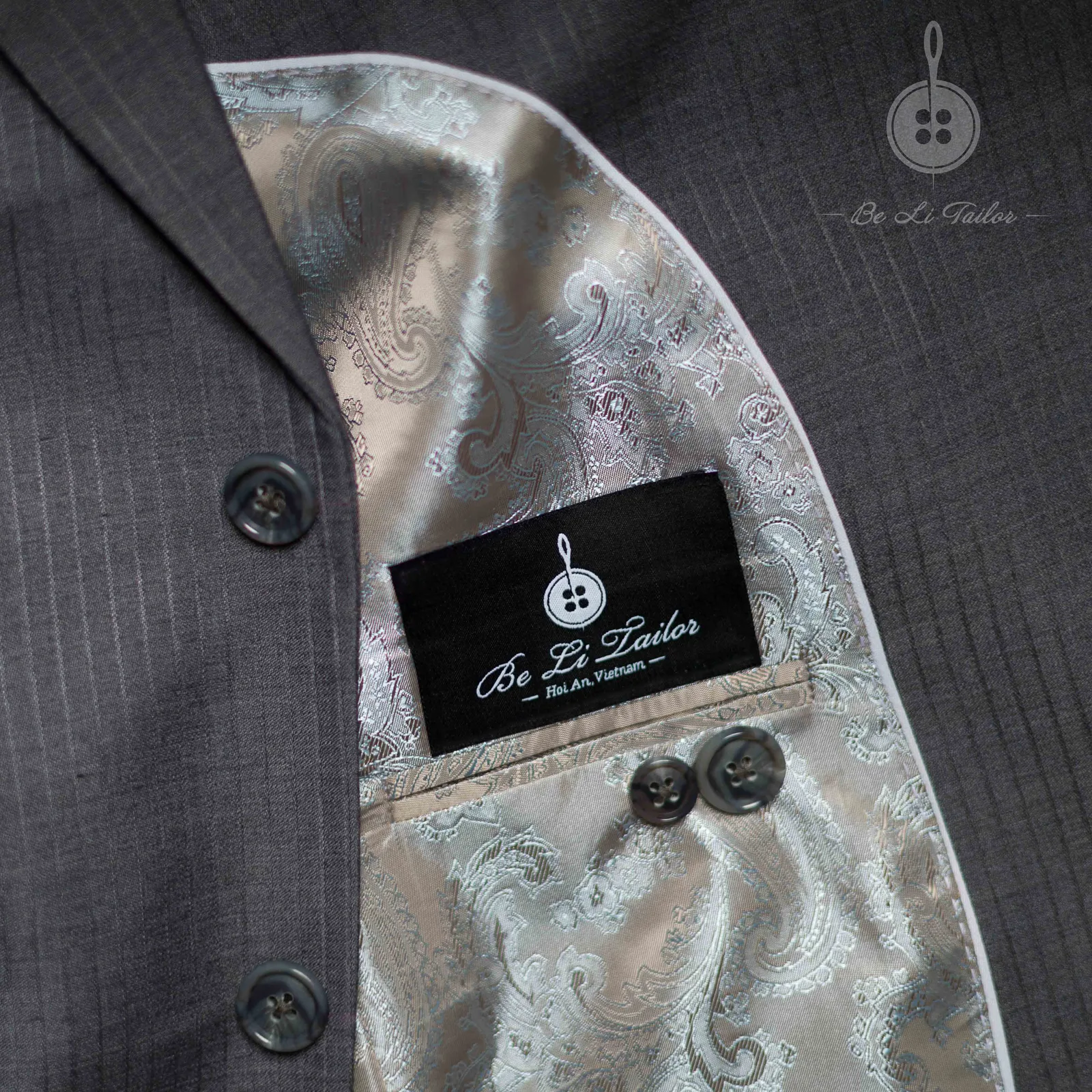
At Be Li Tailor, we use the word bespoke in its precise sense and hold ourselves to the standard it implies. Every garment begins with a pattern drafted by our senior cutter from your individual measurements — not from a modified block, not from a template adapted from a previous customer's pattern, but from a fresh draft made for your body specifically. The measurements we take include not just your standard dimensions but the particular characteristics of your posture and proportions that a standard size system cannot capture.
For structured garments — suits, blazers, tailored coats — we include a fitting at the basted stage as a standard part of the process, not an optional add-on. This is the fitting where the pattern is validated against your body and corrections are made before anything is committed to final fabric. It adds time to the commission, but it is the step that separates a garment that fits from one that merely approximates a fit. We then include a second fitting in the final fabric before the garment is pressed and finished.
The bespoke suits and jackets we make are built with proper internal canvas — horsehair and linen, hand-padded through the chest and lapels in the traditional method. The sleeves are set by hand. The button holes on suit jackets are hand-worked. These are not premium add-ons; they are the standard of construction we apply to everything we make, because we believe that a garment described as bespoke should meet the standard the word has always implied.
We are also transparent about the process and honest about what takes time. A bespoke suit done correctly requires a minimum of five days in Hoi An, ideally seven to ten. If you arrive with less time than that, we will tell you so and discuss what is achievable within your constraints rather than promising something that would require us to cut corners. That honesty is, we think, itself part of what bespoke means: a commitment to the work done properly rather than the appearance of it done quickly.
Our tailoring tradition in Hoi An has been built on these principles since the studio opened, and they are as relevant today as they have ever been — perhaps more so, in an era when the word that describes them has been borrowed by industries that have nothing to do with making clothes by hand for one person at a time.
Commission Something Genuinely Bespoke
Be Li Tailor is at 635 Hai Bà Trưng, Hội An Ancient Town, open daily 8am–9pm. Every garment we make begins with a fresh pattern — no blocks, no compromises. Explore our menswear services or book a consultation to see what bespoke looks like in practice.