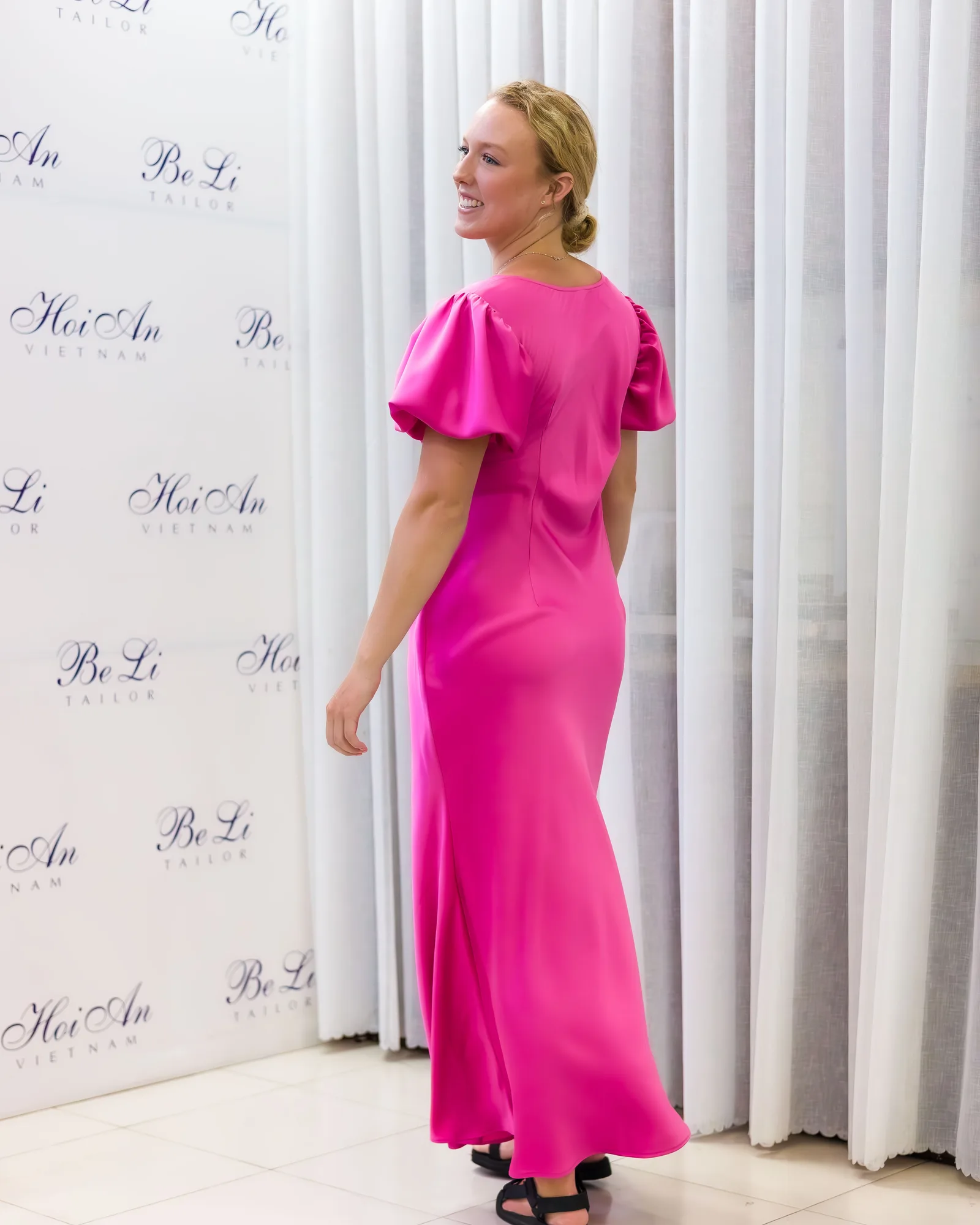
I have a dress problem, and Hoi An is largely responsible for it. Not in a bad way — but the experience of commissioning a dress that fits your body exactly, in the fabric and colour you actually wanted, at a fraction of what it would cost anywhere else in the world, is difficult to walk away from. Every time I've been back to Hoi An, I've left with at least one new dress. More accurately, I've left with several, because the process is so straightforward and the results so consistently right that the restraint required to stop at one feels unreasonable.
I've been buying dresses in Hoi An for several years now. The collection has grown from occasion wear to everyday pieces, from formal silk dresses to relaxed linen shifts, from things I commissioned knowing exactly what I wanted to pieces that emerged from conversations with the tailors and turned out better than anything I could have specified on my own. Here is what I've come to understand about why this city does custom dresses so exceptionally well.
What Makes Hoi An Such an Exceptional Place for Custom Dresses
Custom dresses occupy a particularly sweet spot in Hoi An's bespoke offering. Women's fashion is enormously varied — silhouettes, necklines, sleeve lengths, waist treatments, hem shapes, and fabric choices all interact to produce something that either works for a specific body or doesn't. Ready-to-wear dresses are made for a size, not a shape, and most women have at least one dimension that falls outside the standard grading. A shoulder that's narrower than the chest size, a waist-to-hip ratio that doesn't fit the standard dress, a longer or shorter torso than the template assumes — any of these makes ready-to-wear fit frustrating.
Bespoke resolves all of this. The pattern is cut for your measurements, not adapted from a standard. The bodice fits your chest and waist and shoulders, the skirt falls from your actual hip, the hem is set at the length that works for your height and leg proportion. And in Hoi An, this resolution costs what a mid-market brand dress costs at home — sometimes less — while being made in better fabric with more care.
The depth of expertise in women's bespoke at Be Li Tailor reflects years of working with international customers who come with specific requirements and exacting standards. The studio has developed a genuine fluency in the full range of dress styles — from structured cocktail dresses with boning and lining through to relaxed evening wear and smart everyday pieces — and the quality shows in the garments consistently.
The Fabric Options for Women's Bespoke Dresses
The fabric selection for women's dresses in Hoi An is more varied than most visitors expect. At Be Li Tailor, the range spans lightweight cotton voile and poplin for casual dresses, linen in various weights for relaxed daywear, silk charmeuse and silk crepe for formal and evening pieces, chiffon and organza for occasion wear, and embroidered Vietnamese silk for something truly special. There are also jersey and ponte knit options for more relaxed structured pieces, and a range of cotton-silk blends that behave beautifully in the Vietnamese heat and travel well.
The silk selection deserves particular mention because Vietnamese silk has a character and quality that is often surprising to visitors expecting something generic. The silk produced in and around Hoi An, particularly the silk that comes from the traditional weaving villages in the region, has a weight and drape that differs from Chinese or Thai silk in ways that tailors who work with it daily understand intuitively. A silk dress made in Hoi An from local silk is not just bespoke — it's made from a material that has its own story and place.
Choosing the right fabric is the most important design decision in a dress commission. The tailor should guide you through this choice actively, because fabric weight and hand determine how the silhouette falls and moves. A dress design that works beautifully in a structured cotton may look entirely different in a fluid silk charmeuse. The consultation at a good studio will explore this connection between design and fabric before any commitment is made.
How the Design and Fitting Process Works for Dresses
The dress commission process typically begins with a design conversation that is more detailed than the equivalent for menswear. There are more variables to establish: neckline type and depth, sleeve treatment (length, cut, structure), bodice construction (darted, princess-seamed, banded), waist treatment (fitted, empire, dropped, undefined), skirt shape (A-line, straight, flared, wrap), and hem length. For each of these, there are further choices — a V-neckline might be shallow or deep, wrapped or straight-edged, with or without a facing. A good tailor will walk you through these choices systematically, using sketches or reference images to ensure you're both describing the same thing.
Measurements for a dress cover more points than most people expect: bust at multiple heights, waist, high hip, low hip, shoulder width, shoulder slope, back length, front length, neck width, armhole depth, and sleeve measurements if applicable. For fitted dresses, the tailor will also measure the torso proportions to understand where your natural waist sits relative to your bust and hip — this is critical for getting the waist treatment right.
The fitting, typically held two to three days after the initial consultation, shows the dress in its basted or partly-finished state. This is where you should be most engaged and most candid. Does the bodice sit correctly at the bust? Does the waist hit where you want it? Is the neckline exactly the depth you discussed? Does the hem fall at the right length for the shoes you'll wear with it? Raise every issue you notice — adjustments at this stage cost nothing and prevent disappointment later.
The Styles Be Li Tailor Excels At
Over several years and multiple commissions, a few categories have consistently produced results that I would hold up against anything I could find in a boutique at home. Structured midi dresses in cotton or linen with clean tailored lines are a studio strength — the kind of dress that looks deceptively simple but requires precise pattern cutting and fitting to fall correctly on the body. Silk slip dresses and bias-cut evening pieces are another strength, reflecting the studio's expertise with delicate fabrics and the patience required to handle them. Wrap dresses in lightweight wovens are reliably excellent, because the wrap construction requires precise calibration to the wearer's proportions that ready-to-wear simply cannot achieve.
Wedding dresses and formal gowns require additional time and at least two fittings, but the quality achievable here at prices that would cover a single bridesmaid dress from a Western bridal boutique is genuinely remarkable. If you're planning a destination wedding in Hoi An or simply want to commission something formal for a special occasion, this is one of the best-value propositions the studio offers.
How Custom Dresses From Hoi An Compare to Western Prices
The price comparison requires some context. A simple casual dress in cotton or linen at Be Li Tailor might run $80 to $130, depending on fabric and complexity. A more structured daywear or cocktail dress in silk or quality cotton might be $150 to $250. A formal or evening gown with more complex construction — boning, structured lining, embellishment — might reach $300 to $450. These prices are for garments made precisely to your measurements, in fabric you chose, to a design you specified, with at least one fitting.
The equivalent in any Western city would be dramatically higher. A silk dress of comparable quality from a respected designer label would start at $400 to $600 and could easily be several times that. A formal commission from a dressmaker in London or Sydney would cost at least $800 to $1,200 for basic construction, more for anything complex. The value proposition in Hoi An is not difficult to understand. What may be less obvious until you've experienced it is that the quality difference is often nonexistent — the dresses made here are simply better value, not lower quality.
Why I've Stopped Buying Dresses Off the Rack
The shift happened gradually, over the course of three or four visits to Hoi An. Each time I came home with custom dresses, I found myself reaching for those pieces over everything else in my wardrobe. Not because they were the most expensive or the most elaborate, but because they fit. The shoulder seam sits at the edge of my shoulder instead of dropping down my arm. The waist sits where my waist actually is. The hem hits at a length that works for my height.
When you wear something that fits correctly, you stop noticing it. You wear it naturally, without adjustment, without consciousness. Ready-to-wear dresses — even expensive ones — require a constant low-level negotiation. You hitch the strap, tug at the waist, check that the neckline hasn't shifted. Custom fits differently, and once you've worn it consistently, going back to the alternative feels like a genuine compromise.
If you have a trip to Hoi An coming up and are wondering whether to commission a dress, the short answer is: yes. Book an appointment before you arrive, bring reference images of what you're imagining, and be prepared to spend two to three mornings engaged in the process. The dress you leave with will still be in your wardrobe in five years. The off-the-rack purchases you make this year probably won't be.
Commission Your Next Dress
Be Li Tailor is at 635 Hai Bà Trưng, Hội An, open daily 8am–9pm. Bring a reference image or simply describe what you have in mind — we'll guide you through the fabric and style choices and fit the dress to your body exactly. Book an appointment or explore our womenswear services.