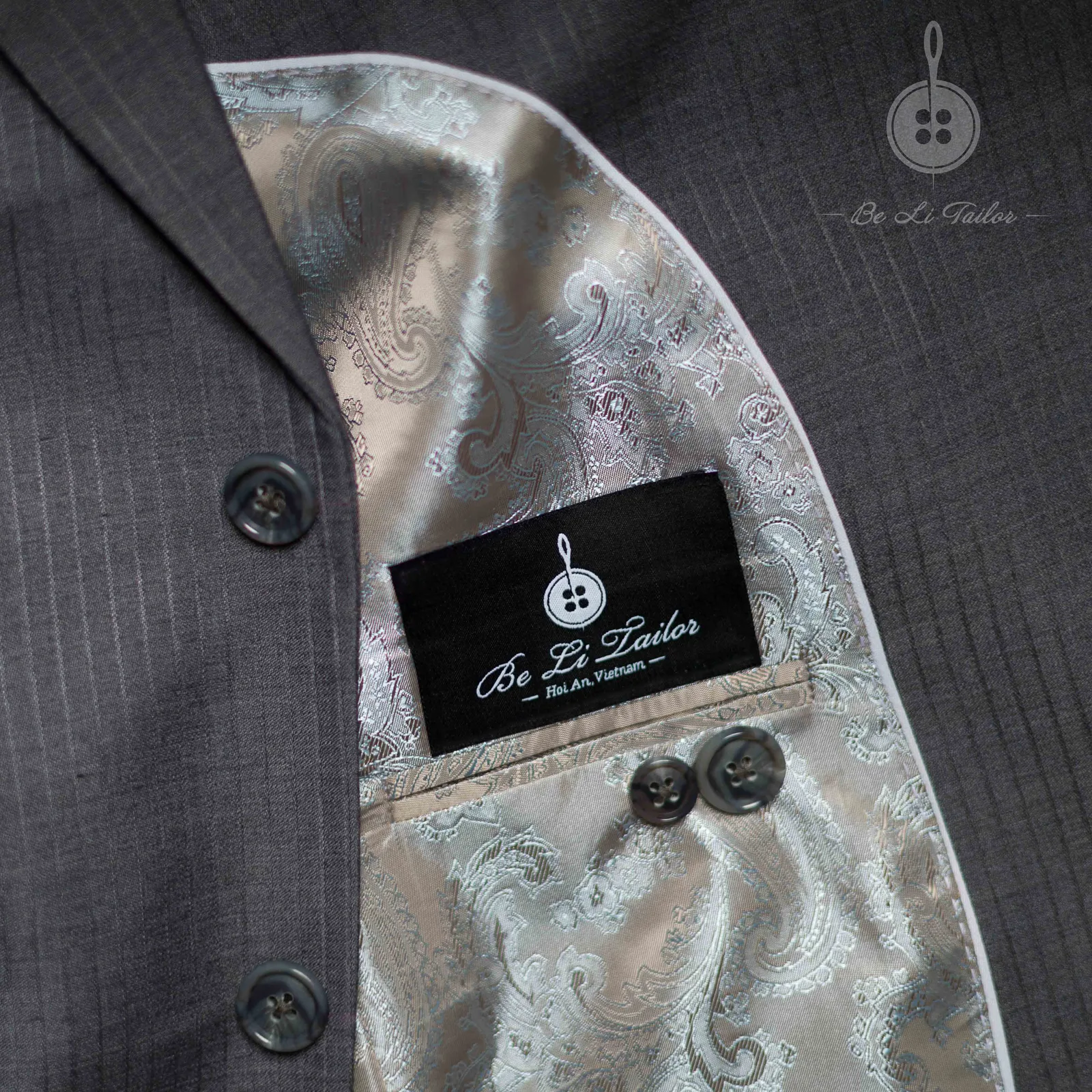
Most clients arrive for their first fitting with a vague sense of how a suit is hand-stitched and little need to know more. The garment they try on feels different from anything they have worn before — it sits on the shoulder correctly, moves with the body rather than against it — and that is enough. But for those who want to understand what actually happens between the measuring tape and the finished suit, this is what the process looks like from the inside.
I have been making suits in Hội An for more than twenty years. The process I describe here is the one we use at Be Li Tailor: traditional bespoke construction, not a streamlined version of it. It takes longer than the fast alternatives. It produces a different result.
The Pattern: Where Every Suit Begins
Before a single length of cloth is cut, a pattern must be drafted. This is not a matter of selecting the closest size from a standard block and making minor adjustments — although that is how much of the ready-to-wear industry operates. A bespoke pattern begins from the client's actual measurements: chest, waist, seat, shoulder width, back length, sleeve length, and a series of more specific points that vary between tailors but all have the same purpose. They translate a three-dimensional body into a set of two-dimensional shapes that, when cut and assembled, will recreate that three-dimension with precision.
The pattern-drafting stage takes experience to perform well. The measurements alone do not produce the pattern — they provide the raw data. The tailor's judgement, trained over years, fills in what measurements cannot capture: posture, how the client carries their shoulders, whether they lean forward slightly, the precise shape of the back. These observations inform adjustments to the base pattern that no measurement chart can anticipate.
Cutting the Cloth: No Margin for Error
Once the pattern pieces are finalised, they are laid onto the fabric and the cloth is cut. This is a stage where there is genuinely no margin for error. Fabric cannot be uncut. A mistake here means waste, delay, and cost.
Good cutting requires understanding how the cloth behaves. Woven fabrics have a grain — a direction in which the threads run — and pattern pieces must be aligned with the grain correctly or the finished garment will twist, pucker, or pull. Striped or checked cloths require additional care: the stripes must match at the seams, which means accounting for the pattern repeat when laying out pieces and accepting that some fabric will inevitably be sacrificed to maintain alignment.
The interlining — typically a canvas material that provides internal structure to the jacket's chest and front — is cut separately and prepared at this stage. In a fully canvassed suit, this canvas will eventually be hand-stitched to the cloth by a process called pad-stitching, which builds the gentle curve and structure of the lapel. This is one of the elements that most clearly distinguishes bespoke from fast construction.
Basting: The Temporary Suit
Before permanent construction begins, the cut pieces are assembled into a basted shell — a rough version of the suit held together with long, easily removed stitches. This basted garment looks something like a suit and almost nothing like one. The seams are not finished. The lining is not inserted. The buttons are not sewn. The sleeves may be simply pinned rather than attached.
But the basted shell captures the critical relationships between the pattern pieces: the shoulder seam, the side seams, the chest, the back. It is this garment that the client tries on at the first fitting — not a finished suit, but a working model of one. Everything that matters for the fit can be assessed at this stage, and changes can be made without undoing finished work.
The First Fitting and What It Reveals
The first fitting is the most important conversation in the tailoring process. The client puts on the basted shell and the tailor looks carefully — at the shoulder, the chest, the back, the way the fabric lies and pulls and drapes. What is seen is translated into chalk marks, pins, and spoken notes.
Common adjustments at this stage include taking in or letting out the side seams to correct the chest or waist, adjusting the back seam for seat fit, raising or lowering the shoulder seam if the pitch is wrong, and correcting the sleeve pitch if the arm is pulling forward or backward. For a thorough account of what the fitting process reveals and what clients should be watching for, our complete guide to commissioning a bespoke suit covers the fitting stages in detail.
After the first fitting, the basted garment is taken apart — the stitches removed, the pieces adjusted according to the marks and notes made during the fitting — and reassembled with the corrections built in. This is not a five-minute process. Unpicking and re-basting a jacket can take several hours.
Construction: The Work Between Fittings
Once the fit has been confirmed — either at the first fitting or a second, depending on how significant the initial corrections were — permanent construction begins. This is the longest stage of the process and the one that most clearly differentiates bespoke from faster methods.
The canvas interlining is pad-stitched to the jacket front by hand. This process involves thousands of small, even stitches made across the entire surface of the chest piece, attaching the canvas to the cloth in a way that allows the two materials to move together while building the gentle roll of the lapel. It cannot be rushed. A full chest canvas, pad-stitched by hand, takes several hours of sustained work.
The collar is shaped and attached. The sleeves are set — inserted into the armhole in a process that requires careful assessment of the sleeve pitch and the rotation of the arm. The lining is cut and inserted. Pockets are constructed. Button holes are worked — in traditional bespoke tailoring, by hand, with a close, dense stitch that no buttonhole machine exactly replicates.
Hand-Finishing: What Separates Craft From Production
The hand-finishing stage is where the suit acquires its final character. The lapels are pressed and shaped over a tailor's ham to set the roll correctly. The collar is steamed and moulded. The hem of each sleeve is hand-stitched with a blind stitch that is invisible from the outside. The trouser seat and knee are pressed with steam and careful manipulation to remove any tension from the cloth and allow the grain to settle into its correct position.
The buttons are sewn on with a thread shank — a small column of thread between the button and the cloth — which allows the button to lie flat when the jacket is fastened without pulling the buttonhole. Finishing thread is knotted and buried inside the cloth rather than cut close to the surface. A suit that has been properly hand-finished will look better after its first pressing than it did when new, because the heat and weight of the iron complete the shaping that the tailor began.
The difference between a hand-finished suit and a production-line garment is most apparent in this stage. Production tailoring shortcuts almost all of it.
The Final Fitting and Delivery
The final fitting is a confirmation rather than a correction stage — ideally. The finished suit is presented to the client for a last assessment. Minor adjustments can still be made at this point: a slight adjustment to the trouser break, a small alteration to the sleeve length. But the major work is done, and the session should take no more than fifteen or twenty minutes if the earlier fittings were conducted well.
For clients who want to understand more about what the process looks like from the tailor's perspective — and what distinguishes full bespoke from the various intermediary options — our article on alterations versus bespoke tailoring covers the distinctions clearly. To see the studio where this work is done, read our story or simply book an appointment.
Frequently Asked Questions
How long does it take to hand-stitch a suit?
A fully hand-stitched bespoke suit requires between 40 and 80 hours of skilled labour, depending on the complexity of the garment and the level of hand-finishing involved. In practice at Be Li Tailor, the process from first measurements to final delivery takes three to five days for a standard commission — this reflects a team working concurrently on different stages of construction rather than a single tailor working sequentially.
What parts of a suit are sewn by hand?
In a fully bespoke suit, the following are typically hand-worked: pad-stitching of the canvas interlining, buttonholes, sleeve hems (blind-stitched), the pick stitch along the lapel edge and pockets (if specified), the collar attachment, and various finishing details including sewing on buttons with a thread shank. Machine sewing is used for structural seams where hand-stitching would add no appreciable benefit — the long seams of the back, side, and trousers, for example.
What's the difference between hand-stitched and machine-made?
The most significant difference is in the internal structure. A hand-stitched suit uses a canvas interlining that is attached to the cloth by thousands of small pad stitches, creating a living structure that moves with the body and develops to its wearer's shape over time. A machine-made suit typically uses a fused interlining — a stiffened fabric bonded to the cloth by heat — which cannot be pad-stitched and which tends to delaminate and stiffen further with repeated cleaning. Hand-stitching also appears in buttonholes, hems, and finishing details that contribute to a garment's long-term durability and appearance.
Visit the Studio
Be Li Tailor is at 635 Hai Bà Trưng, Hội An Ancient Town, open daily from 8am to 9pm. Whether you're arriving next week or planning ahead, book your appointment online or reach us on WhatsApp at +84 905 820 116. We keep every client's measurements on file — if you've visited before, your next commission starts where the last one ended.