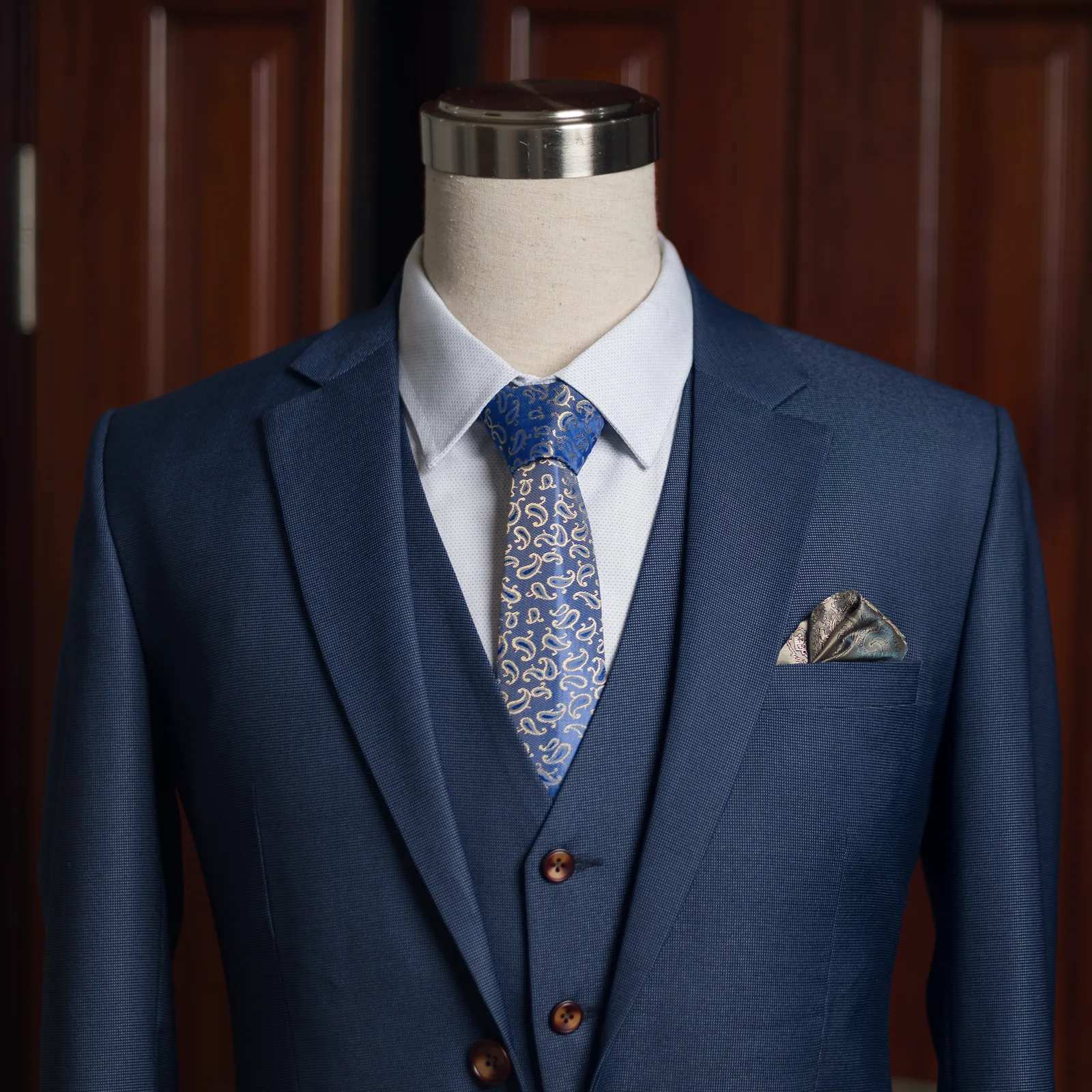
A bespoke suit guide written in 2025 needs to do something that most of its predecessors have not: cut through the accumulated mythology around bespoke tailoring and describe, in plain terms, what the process actually involves, what it produces, and whether it is the right choice for a given person and occasion. Bespoke is not for everyone, and no honest tailor should claim otherwise. But for clients who are the right fit for the process, a properly made bespoke suit is among the most enduring and rewarding investments in a wardrobe.
This guide covers everything from the definition of bespoke itself to the practical details of what you should expect at each stage of the commission, and how to get the most from a suit once it leaves the studio. It is written primarily for clients commissioning a suit in Hội An — though the principles apply wherever in the world the work is being done.
What "Bespoke" Actually Means (And What It Doesn't)
The word "bespoke" comes from the English verb "to bespeak" — meaning to speak for, or to reserve. When a customer visited a cloth merchant and a particular bolt of fabric was "bespoken," it was set aside specifically for them. The garment made from it would be theirs alone.
In contemporary tailoring, bespoke has a specific and meaningful definition: a garment is bespoke if it is made entirely from scratch for a single client, beginning with a unique paper or card pattern drafted from the client's measurements, constructed through a series of fittings in which the work in progress is presented on the client's body and adjusted accordingly, and finished according to the client's individual specifications. No two bespoke garments are the same, because no two bodies and no two sets of preferences are the same.
What bespoke does not mean, despite widespread misuse of the term, is "customised." A suit that allows you to choose a fabric and add a few options from a menu — button count, lining colour, lapel width from a limited selection — is not bespoke. It is made-to-order, or sometimes made-to-measure, depending on whether the pattern is adjusted for the individual. The term "bespoke" has been diluted significantly by the fashion industry's marketing departments, and it is worth being clear about what you are actually purchasing before committing to a commission anywhere in the world.
Bespoke vs. Made-to-Measure vs. Off-the-Rack: The Real Differences
Understanding the differences between these three categories is essential for making an informed choice. Each has genuine advantages and appropriate use cases; none is universally superior.
Off-the-rack (ready-to-wear)
Off-the-rack suits are manufactured in advance, in standard sizes, without reference to any individual customer. They are produced efficiently and at scale, which means they can be made at significantly lower cost than bespoke. The trade-off is that the fit will be approximate at best for any specific body — the garment is designed around an average form that no individual exactly matches. For clients whose proportions happen to align closely with the manufacturer's standard sizes, off-the-rack can produce acceptable results with minor alterations. For most people, the fit compromises are significant and visible.
Made-to-measure
Made-to-measure (MTM) sits between off-the-rack and bespoke. A standard base pattern is adjusted for the individual customer based on their measurements, and the resulting garment is manufactured specifically for them. The fit improvement over off-the-rack is typically meaningful — the garment should accommodate the client's actual measurements rather than average ones — but the adjustments are limited to modifying an existing pattern rather than creating a unique one. MTM cannot address unusual proportions — a short rise, asymmetric shoulders, a significant difference between the jacket chest and waist — as well as true bespoke construction.
Bespoke
A genuinely bespoke suit begins with measurements taken by an experienced tailor, proceeds through pattern drafting specific to those measurements, and involves one or more fittings at the toile (first fitting garment) stage before any final cloth is cut. Adjustments at the fitting stage allow the tailor to address individual posture, asymmetry, and preference in a way that no other process can. The result is a garment that fits the specific client rather than a general standard.
If you are uncertain which category your potential commission falls into, ask the tailor directly: do they draft a new pattern for each client, and do they offer a toile fitting? These two questions will clarify the situation immediately. For more on the differences between bespoke and alterations more broadly, our article on alterations vs bespoke tailoring in Hội An addresses some of the common points of confusion.
Choosing Your Cloth: Where to Start
For most clients commissioning their first bespoke suit, fabric selection is both the most exciting and the most overwhelming part of the process. Walking into a studio with hundreds of fabric books, each containing dozens of swatches, can produce decision paralysis. The practical approach is to narrow the field before you begin considering specific swatches.
Start with the climate and occasion. A suit for Hội An's climate in the 28–35°C range needs to be in the 190–230gsm range in an open weave construction — fresco, hopsack, or tropical worsted. This eliminates most of the fabric range immediately. If the suit is primarily for formal occasions, you are looking at wool or wool-blend options. If it's for casual wear, linen and linen blends become relevant. Our complete fabric guide for tropical tailoring walks through every major category in detail.
Next, consider colour. Practical first suits are typically in navy, mid-grey, or charcoal — colours that are versatile across a wide range of occasions and easy to combine with existing wardrobes. Once you have established suits in those neutrals, patterns and unusual colours become much more rewarding to explore, because you have the anchors in place.
Pattern choice follows colour. A plain, solid fabric is the most versatile choice for a first suit and the most forgiving in construction — pattern matching in stripes and checks adds complexity and cost to the tailoring process. A subtle herringbone or fine stripe is a reasonable middle ground if you want some visual interest without committing to a bold pattern.
Finally, consider weight and finish in more detail. A fresco weave at 210gsm will have a slightly rough, textured surface. An open tropical worsted at the same weight will be smoother and lighter in appearance. Both breathe well; the choice is partly aesthetic and partly about how the suit fits into the rest of your wardrobe.
Construction: What Separates a Good Suit From a Great One
The cut of a suit — the silhouette, the proportions — is what most people focus on. But the quality of a suit's construction is what determines whether it wears well for five years or fifteen, whether it retains its shape through regular use, and whether the fit remains accurate as the garment settles and responds to the wearer's body over time.
Canvas construction
The single most important construction detail in a tailored jacket is the canvas — the internal structure that gives the chest and lapel their shape. In a fully canvassed suit, a layer of woven horsehair canvas is attached to the jacket's front sections using a technique called pad-stitching: rows of hand stitching that attach the canvas to the outer fabric without gluing them together. Over time, through wear, this construction allows the canvas to mould to the wearer's chest, producing a fit that improves with time rather than degrading.
A half-canvassed suit uses canvas only through the chest and lapel, with the lower body sections using a lighter fusible interlining. This is a reasonable compromise for lighter-weight tropical fabrics and unlined jackets. A fully fused suit — in which the entire front is glued to an interlining rather than canvassed — will typically begin to separate and bubble at the fusing points after regular dry cleaning, a problem that is irreversible.
At Be Li Tailor, all our bespoke suits are fully canvassed or half-canvassed depending on the weight and construction of the chosen fabric. For our full bespoke menswear service, canvas construction is a standard part of the process.
Seam finishing and hand sewing
In a well-made bespoke suit, certain elements are sewn by hand rather than machine: the attachment of the canvas to the chest, the setting of the sleeves into the armhole, the buttonholes, and sometimes the collar attachment. Hand-sewn elements allow the tailor to manage the tension and distribution of each seam individually, producing a result that a sewing machine — working at consistent speed with consistent tension — cannot fully replicate. Hand finishing is time-consuming and adds to the cost of a garment, but it is one of the clearest indicators of genuine craft.
Lining
A jacket's lining protects its internal construction and allows it to move freely over clothing worn underneath. The quality of the lining matters both in terms of the material (silk and bemberg breathe better than polyester) and in terms of how it is attached — a lining that is too tight will pull the jacket out of shape, while one cut with appropriate ease will move with the jacket without restriction. In a well-made garment, the lining is attached with a small amount of ease at the hem and vents, allowing the jacket to open naturally without pulling the interior down.
The Details That Define a Suit: Lapels, Buttons, Linings
The details of a bespoke suit are where personal expression enters the process. Most of them have functional origins — working buttonholes are actually workable, surgeon's cuffs allow the sleeves to be rolled up — but all of them contribute to the overall personality of the garment.
Lapels
Lapel width and style are among the most visible style statements a suit makes. Current mainstream suiting tends toward medium-width lapels — roughly 7–8cm at the widest point — which read as modern without being trend-dependent. Wider lapels (9–10cm) give a more generous, 1970s-influenced look. Narrow lapels (below 6cm) can date a suit quickly, as they are more closely associated with specific trend cycles than the medium width. Peak lapels — where the lapel points upward toward the shoulder seam rather than down and out — are more formal and dramatic than notch lapels and suit structured, formal suits particularly well. Shawl lapels are reserved almost exclusively for black-tie and dinner jacket contexts.
Buttons
Suit buttons are typically made from horn, corozo (a natural vegetable ivory), or synthetic resin. Horn and corozo are more expensive but wear more attractively than resin — they develop a patina rather than scratching and dulling. The number of jacket buttons is a style decision: a two-button jacket is the standard for most modern suits; a three-button works well on a tall frame; single-button is reserved for formal occasions. Sleeve buttons — usually four per cuff — are traditionally sewn close together and overlapping, with the last button able to actually be undone (working, or "surgeon's," cuffs). This is a detail worth specifying in a bespoke commission.
Lining and interior details
The interior of a bespoke suit jacket is typically lined with a contrasting or complementary fabric, and the choice here is an opportunity for quiet individuality. A plain navy suit with a burgundy or forest green lining is a detail visible only to the wearer and whoever helps them into the jacket. A printed lining — a fine stripe, a small geometric, a subtle all-over print — adds personality without altering the external presentation of the suit. We carry a range of lining options in our studio, and we encourage clients to choose something they will enjoy discovering each time they put the jacket on.
Fit: The Only Thing That Really Matters
Every element of a bespoke suit — the fabric, the construction, the details — exists in service of the fit. A suit that fits perfectly in an average fabric with modest details will look better and feel better than an extraordinary fabric with elaborate detailing that does not sit correctly on the wearer's body. Fit is the foundation; everything else is refinement.
The key fit points in a jacket are the shoulder seam (which should sit at the edge of the shoulder bone, not beyond it or inside it), the chest (which should button without pulling but have no excess fabric pooling at the front), the waist suppression (the jacket should follow the waist rather than being a straight tube, regardless of how formal or casual the style), and the sleeve length (the jacket sleeve should end approximately 1.5–2cm above the shirt cuff). Trousers need to be considered at the waistband, the seat, the thighs, and the break — the amount of trouser fabric that rests on the shoe when standing.
Our detailed guide to how a bespoke suit should fit covers every measurement point with specific guidance on what to look for and how to recognise problems. It is worth reading in conjunction with this guide before your first fitting.
In a bespoke process, the fitting stage is where fit is refined rather than achieved on the first attempt. The toile fitting — conducted in a rough calico version of the jacket before the final cloth is cut — is specifically designed to identify and address fit issues before they are worked into an expensive piece of fabric. A competent tailor should be making notes and adjustments throughout this process, and you should feel empowered to articulate what is or is not working without concern about causing offence.
How to Commission a Bespoke Suit in Hoi An
Hội An has established itself over the past two decades as one of the world's most accessible destinations for quality bespoke tailoring. The concentration of skilled tailors, the availability of quality imported cloth, and the relatively short turnaround times that the Hội An tailoring industry has developed make it genuinely possible to commission a well-made bespoke suit during a holiday stay of one to two weeks.
The process at Be Li Tailor begins with a consultation — typically 30–45 minutes for a first-time client — in which we discuss fabric options, style preferences, the occasions for which the suit will be worn, and any specific requirements or constraints (travel demands, existing wardrobe, preference for particular construction details). We take a comprehensive set of measurements at this appointment, including not just standard dimensions but posture observations, shoulder asymmetry, and carry — the way the client naturally holds their body when standing and moving.
A toile fitting is then conducted in a first-draft garment, which allows us to refine the fit before cutting the final cloth. For clients with challenging proportions or high fit requirements, we offer a second toile fitting. The final garment is then cut, constructed, and presented for a final fitting before completion. The full process typically takes five to seven days for a two-piece suit, including fittings.
For clients who are not visiting in person, we also work with clients who send measurements in advance, ship the finished garment internationally, and welcome returning clients whose measurements are already on file. Several of our long-standing clients commission two or three garments per year without visiting Hội An for every order.
If you are planning a visit and want to understand more about the tailoring experience before arrival, our guide to alterations vs bespoke tailoring in Hội An answers many of the common questions about what is achievable within a typical travel schedule.
What to Do With Your Suit When You Get Home
A bespoke suit represents a meaningful investment of both money and time, and it deserves proper care. The most important habits to establish from the beginning are:
Rotation
Wool fibres need time to recover between wears. A suit worn every day will age noticeably faster than one rotated through a small collection. If the suit is intended for regular use, having at least two suits to alternate between will significantly extend the life of both.
Brushing
A soft-bristled clothes brush, used after each wear, removes surface soil, raises the nap of the fabric slightly, and prevents dust and debris from working their way into the fibre. This is one of the simplest and most effective maintenance practices for any tailored garment.
Hanging and resting
Hang the suit on a shaped wooden hanger — never wire, which distorts the shoulder line — between wears. Allow at least 24 hours between consecutive wears to give the wool fibres time to release any moisture absorbed during wear and recover their structure.
Dry cleaning sparingly
Dry cleaning is a chemical process that gradually degrades wool fibres. Have a bespoke suit dry-cleaned only when necessary — ideally no more than once or twice a year, and only when spot-cleaning has proven insufficient. Between dry-cleaning sessions, steaming (from a distance, using a clothes steamer, not direct contact with an iron) will refresh and dewrinkle a wool suit effectively.
Alterations over time
Bodies change over time, and a suit that fitted perfectly at commission may require adjustment after a few years. A well-made bespoke suit is designed with this in mind: seams are left with sufficient ease to allow the garment to be let out or taken in at the waist, seat, and chest. Return visits to the studio, or visits to a trusted local tailor at home, can keep a suit in active service for many more years than one that is stored once it no longer fits precisely.
Frequently Asked Questions
What is the difference between bespoke and made-to-measure?
Bespoke means a unique pattern is drafted from scratch for the individual client, the garment is fitted on the client's body during construction, and all specifications are determined by the client. Made-to-measure modifies an existing standard pattern to accommodate the client's measurements, which produces a better fit than off-the-rack but cannot address unusual proportions or posture characteristics as thoroughly as a true bespoke pattern. The key questions to ask a tailor are: do they draft a new pattern for each client, and do they offer a fitting in the work-in-progress garment before the final cloth is cut?
How long does a bespoke suit last?
A well-made bespoke suit in quality cloth, properly cared for, should last twenty years or more. The combination of high-quality construction, cloth that improves with age and wear, and the ongoing ability to alter the garment as the body changes means that the investment amortises very favourably over time. The suits that fail prematurely do so because of poor fabric quality, poor construction (fused rather than canvassed), poor care, or the failure to make small alterations when the body changes gradually over years.
How many fittings does a bespoke suit require?
A minimum of two fittings is typical for a genuine bespoke commission: one toile (first-draft) fitting and one final fitting before the garment is completed. Clients with complex proportions or high fit standards may benefit from a second toile fitting. In Hội An's tailoring context, where many clients have limited time, we work efficiently within available schedules — but we do not compromise on the toile stage, as this is where most significant fit issues are identified and resolved.
What should a bespoke suit cost?
The cost of a bespoke suit varies significantly by location and tailor. In London's Savile Row, a bespoke two-piece suit begins at around £4,000–£5,000 and rises considerably for the most established houses. In Hội An, quality bespoke tailoring is available at a fraction of that cost, reflecting lower overheads rather than inferior craft — the tailors here have comparable skills and use the same quality imported cloths. The fabric selected will significantly affect the final price, as premium imported woolens from British and Italian mills carry a cost premium over domestic alternatives. We are happy to discuss pricing transparently during any consultation.
Can I get a bespoke suit made in two days in Hoi An?
A suit can be produced in two days in Hội An, but it will not be a properly bespoke suit by any meaningful definition. Two days is insufficient time for a toile fitting, adjustments, cutting the final cloth, construction, and finishing to a quality standard. What is typically delivered in a two-day turnaround is a made-to-measure garment with a compressed construction process — which is not necessarily a poor garment, but it is not what this guide describes. At Be Li Tailor, we recommend a minimum of five to seven days for a two-piece bespoke suit, which allows for the full fitting process without rushing the construction.
Visit the Studio
Be Li Tailor is at 635 Hai Bà Trưng, Hội An Ancient Town, open daily from 8am to 9pm. Whether you're arriving next week or planning ahead, book your appointment online or reach us on WhatsApp at +84 905 820 116. We keep every client's measurements on file — if you've visited before, your next commission starts where the last one ended.