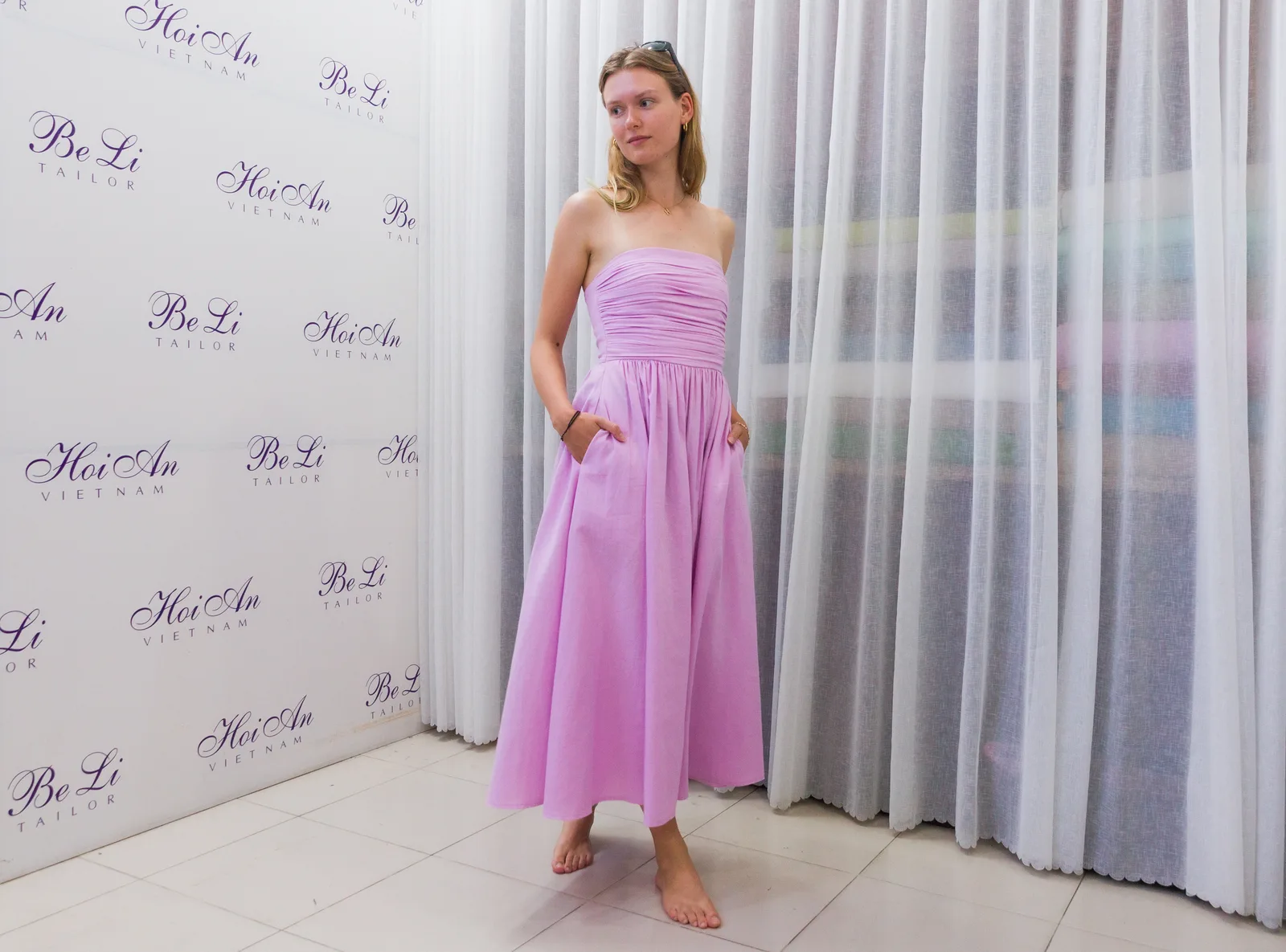
Commissioning a custom Áo Dài in Hội An is one of the most culturally resonant things a visitor to Vietnam can do. The Áo Dài is Vietnam's national garment — a high-collared tunic worn over wide-leg trousers — and Hội An, with its centuries of textile tradition and dense concentration of skilled tailors, is one of the best places in the country to have one made. At Be Li Tailor, we make Áo Dài for Vietnamese clients attending formal occasions and for international visitors who want a garment that means something beyond a souvenir.
This guide covers the history and cultural significance of the Áo Dài, how the silhouette has evolved, what fabric choices are appropriate, and what to consider when commissioning one.
The History and Meaning of the Áo Dài
The Áo Dài as we recognise it today emerged in its modern form during the 1930s, though its roots go back several centuries to earlier Vietnamese tunic styles. The name translates literally as "long garment" — Áo meaning garment, Dài meaning long. Its distinctive silhouette — a fitted tunic with a diagonal collar closure and side slits from the hip to the hem, worn over white or matching trousers — became codified over the twentieth century as both a national symbol and a marker of Vietnamese feminine identity.
During the 1950s and 1960s, fashion designers in Saigon modernised the silhouette considerably, introducing raglan sleeves, a more fitted waist, and a wider range of fabric choices. The Áo Dài became the standard uniform for female students and government workers, and it remains a formal dress code for many occasions today — graduations, traditional ceremonies, Tết (Vietnamese New Year), and formal workplace settings.
In Hội An specifically, the Áo Dài has particular significance. The town's tailoring culture means that bespoke versions — fitted precisely to the wearer — are the norm rather than the exception, and the quality of workmanship available here is among the best in the country.
Traditional vs. Contemporary: How the Silhouette Has Evolved
The traditional Áo Dài is characterised by a few non-negotiable elements: the high mandarin collar (thường called the cổ truyền collar), the asymmetric front closure that runs from the neck diagonally to the right side at the waist, and the long tunic panels — front and back — that fall to ankle or floor length and are slit from the hip. The trousers underneath are wide and fluid, typically in white silk or matching fabric.
Contemporary interpretations retain these core elements but allow considerable variation in fit and detail. Modern Áo Dài may feature:
- A more closely fitted bodice with princess seams rather than simple darts
- Shorter tunic lengths — to the knee or just below — for a less formal, more contemporary read
- Modified collar heights, including a lower or boat-neck variation
- Printed or embroidered fabrics in bolder patterns
- Sleeve variations, from full-length to three-quarter or cap sleeves
- Trousers in contrasting colours rather than matching or white
For a first commission, many clients find the traditional silhouette with a high collar and floor-length panels the most satisfying — it is the definitive version of the garment, and it photographs beautifully. For clients who want something more wearable in everyday contexts, a contemporary interpretation gives more flexibility.
Fabric Choices for an Áo Dài
Silk is the traditional and preferred fabric for a formal Áo Dài. Silk charmeuse has the most fluid drape; silk crepe gives a slightly more structured result. Both are appropriate. For a less formal or more everyday version, a linen-silk blend works well — it offers the breathability of linen with enough drape to hold the silhouette.
For heavily embroidered or patterned Áo Dài, silk brocade or silk damask is used. These fabrics have a woven pattern rather than a printed one, and they add significant visual weight and formality to the garment.
Our tropical fabric guide discusses how different fabrics behave in Hội An's climate. For a garment as fitted as the Áo Dài, fabric weight and breathability matter — pure silk breathes better than a synthetic blend and moves more naturally against the body.
We advise against polyester or synthetic blends for an Áo Dài. The garment's beauty is partly in how it moves, and synthetic fabrics do not drape or flow in the same way. There is no functional reason to use them when silk is available at a modest price point here.
Commissioning an Áo Dài: What to Consider
The consultation for an Áo Dài follows the same process as any custom dress commission at Be Li Tailor — measurements, style discussion, fabric selection — with some additional considerations specific to the garment.
The collar height and closure placement are important early decisions. A high traditional collar requires precise fit to be comfortable; if you have a shorter neck or find high collars constricting, we can discuss options. The placement of the diagonal closure is also a fit point — it should sit cleanly at the right side of the waist without pulling or gaping.
The length of the tunic panels is a choice between formality and practicality. Floor-length panels are most traditional but require care when moving — particularly in Hội An's stone streets. Midi-length panels (to the calf) are slightly less formal but considerably easier to wear through a day of sightseeing or a wedding reception.
Allow four to six days for a well-made Áo Dài. Two fittings are standard; for a first commission, a third fitting gives us more confidence in the collar fit and overall line. Ready to discuss your commission? Book an appointment online before you arrive.
When and Where to Wear an Áo Dài
For Vietnamese clients, the contexts are established: weddings, Tết, graduation ceremonies, formal workplace settings, cultural festivals. The garment carries specific social meaning in each of these contexts and is understood as formal and respectful.
For international visitors who have commissioned an Áo Dài, the question is more open. The garment is perfectly appropriate to wear in Vietnam — at cultural sites, at dinners, at special occasions. Many clients wear their Áo Dài at home for formal events, photoshoots, or simply because they have a beautiful garment they want to wear. The Vietnamese community generally receives visitors wearing an Áo Dài with warmth, particularly when the garment is custom-made rather than a purchased costume.
Frequently Asked Questions
Can tourists get an Áo Dài made in Hội An?
Yes, and Hội An is one of the best places in Vietnam to do so. The city's tailoring tradition means skilled cutters with experience making the garment are widely available. Be Li Tailor makes Áo Dài for both Vietnamese and international clients. We'll discuss fit, fabric, and whether you want a traditional or contemporary interpretation at your consultation.
How long does it take to make an Áo Dài?
A well-made Áo Dài typically takes four to six days, including two to three fittings. The collar fit and the diagonal closure are precision points that benefit from time. If you're on a short trip, let us know your departure date and we'll be direct about what is achievable. We do not recommend rushing a garment of this detail.
What fabric is used for an Áo Dài?
Silk is the traditional and preferred choice — silk charmeuse for maximum drape, silk crepe for a slightly more structured result. Linen-silk blends are a practical option for warmer days or less formal occasions. Silk brocade and damask are used for heavily formal or embroidered versions. We advise against synthetic fabrics, which do not drape or move with the same quality as natural silk.
Is it respectful for tourists to wear an Áo Dài?
When worn with genuine interest and care — particularly when custom-made rather than purchased as a costume — the Áo Dài is generally received positively by Vietnamese people. It is understood as an expression of appreciation for Vietnamese culture. The context matters: wearing an Áo Dài at a cultural site or special occasion reads differently from wearing it as a casual outfit. If in doubt, ask us — we'll give you an honest answer based on your specific situation.
Visit the Studio
Be Li Tailor is at 635 Hai Bà Trưng, Hội An Ancient Town, open daily from 8am to 9pm. Whether you're arriving next week or planning ahead, book your appointment online or reach us on WhatsApp at +84 905 820 116. We keep every client's measurements on file — if you've visited before, your next commission starts where the last one ended.