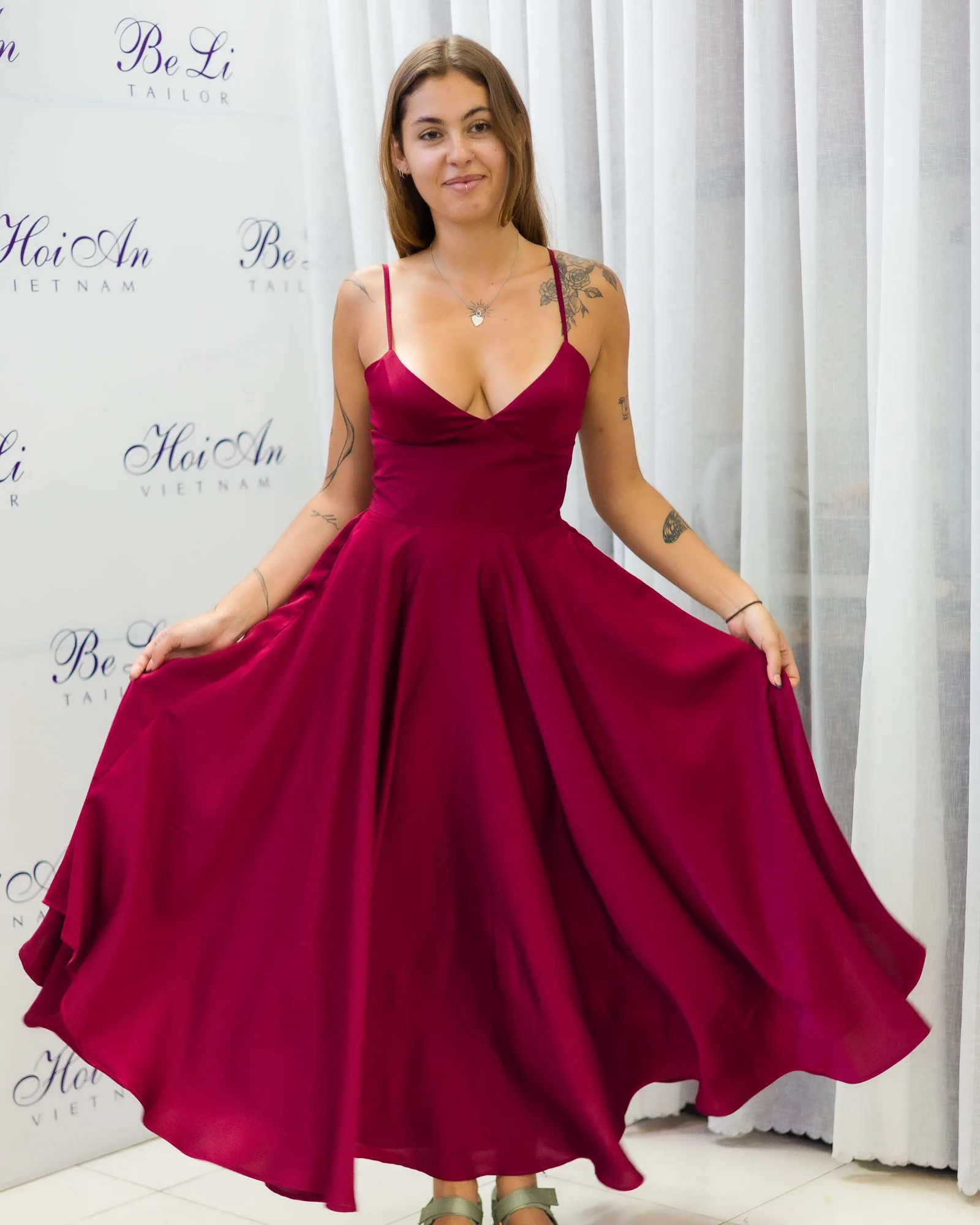
Custom dresses in Hội An are one of the best value commissions you can make anywhere in the world. The city has been a centre of textile production and tailoring for centuries, and for travellers who are willing to invest a few days and a considered conversation with a skilled cutter, the result is clothing that fits with a precision that is genuinely difficult to replicate elsewhere. This guide covers everything — what you can have made at Be Li Tailor's womenswear studio, how to choose fabric and silhouette, what the fitting process looks like, and how your dress gets home.
Whether you're after a simple linen shift for the rest of your trip, a silk evening gown for a forthcoming occasion, or a wedding dress that reflects who you actually are, the process starts the same way: a conversation in the studio about what you need, what you like, and what will work.
What You Can Commission at Be Li Tailor
The range of custom dresses we make covers most categories of womenswear. The most common commissions we receive include:
- Casual and resort dresses — linen shifts, cotton sundresses, wrap styles, midi and maxi lengths for travel and warm-weather living
- Smart casual dresses — shirt dresses, A-line dresses, fit-and-flare styles in fine cotton, linen-silk, or lightweight wool blends
- Cocktail and formal dresses — knee-length to midi, typically in silk crepe, silk dupioni, or structured cotton; suitable for events, dinners, and occasions where looking intentional matters
- Evening gowns — floor-length formal wear in silk, chiffon, or velvet, with or without lining, often with detailed bodice work, draping, or beading
- Wedding dresses — bespoke bridal gowns for destination weddings or for clients who want something unique; our wedding tailoring page covers this in more detail
- Two-piece sets — coordinated tops or blouses with skirts or wide-leg trousers, which function as a dress while giving more versatility
We do not operate from a look-book or catalogue. You bring the brief — a photograph, a sketch, a feeling — and we build from there. If you arrive with a reference image and fabric in mind, we can often cut a pattern the same day.
The Consultation: Style, Fit, and Fabric
The consultation is the most important appointment. It typically takes between thirty minutes and an hour, depending on how complex your commission is and how much you've already decided. You don't need to arrive with everything figured out — part of our work is helping you clarify what you actually want.
We'll ask about:
- The occasion — what you're wearing the dress for, where, and in what climate
- Your fit preferences — whether you prefer things to skim the body or sit away from it; how you feel about different necklines; whether there are areas you want to emphasise or minimise
- Style references — photographs, garments you already own and love, or descriptions of what you're looking for
- Fabric — whether you have a preference, or whether you'd like us to recommend based on the occasion and season
- Timeline — how many days you have in Hội An and when you need the garment
We take your measurements during this appointment. We measure comprehensively — not just bust, waist, and hip, but across the shoulders, through the torso, and at every point that will affect how the garment sits on your specific body. These measurements stay on file, which is useful if you ever want to commission something remotely or return for future work.
Our guide to what to expect at your first tailor fitting covers the consultation process in more depth, including how to prepare and what questions to ask.
Choosing Your Fabric for Different Garments
Fabric choice is where a good commission separates from a great one. The wrong fabric for a silhouette — however well cut — produces a garment that looks flat, wears poorly, or simply doesn't do what it was supposed to. Here is how to think about fabric by dress category.
Resort and casual dresses
Linen is the default choice for casual warm-weather dresses. It breathes better than almost any other fabric, softens with washing, and has an unhurried quality that suits travel and heat. A medium-weight linen in a relaxed cut is one of the most practical and enduring garments you can commission. Cotton is a close second — particularly in percale or voile weights for lighter styles. Our guide to fabrics for tropical tailoring covers these in detail.
Smart casual and cocktail dresses
Silk crepe is the most versatile choice for dresses in this category. It has enough structure to hold a clean line, enough drape to move well, and a surface that reads as formal without being showy. Silk dupioni gives more body and a subtle texture. Linen-silk blends offer breathability combined with a more refined drape than pure linen alone. Fine cotton piqué or poplin works well for structured styles — particularly shirt dresses and fit-and-flare cuts.
Evening gowns and formal wear
For floor-length formal wear, silk charmeuse and silk crepe are the benchmark. They drape with a fluidity that synthetic alternatives cannot match. Silk chiffon works for overlay panels and full-volume skirts. Velvet — whether silk velvet or more affordable cotton velvet — is excellent for cooler-season events and reads as genuinely luxurious. Organza is used for structured elements: collars, overlays, or as a backing for embellishment.
We carry a range of fabrics in the studio and can advise on which will best serve your specific brief. For unusual or specific requests, we can often source materials that aren't on the floor — allow an extra day or two for this.
Silhouette and Fit: Working With Your Body
One of the central advantages of a custom dress is that it is built around your actual body, not a standardised size chart. This matters more than most people realise before they experience it. A well-fitted garment sits differently on the body — it moves with you rather than against you, and it doesn't require constant adjustment throughout the day.
Here is how we think about silhouette by body shape:
Hourglass proportions
Most silhouettes work well. Column cuts, wrap styles, and fitted A-lines all emphasise the proportional balance. The main consideration is ensuring the garment follows the body's natural line rather than being cut straight through — off-the-rack garments almost universally fail here because the cut must accommodate a range of proportions rather than a specific one.
Fuller bust
Neckline matters significantly. A V-neck or scoop creates length and proportion; a high round neck can create compression. We cut princess-seam bodices rather than darted bodices where possible, as they distribute fullness more evenly. Support is built in where needed rather than relying on a separate undergarment.
Narrow shoulders or wide hips
A subtle shoulder detail — a small cap sleeve, a gentle off-shoulder line, or a wider neckline — creates visual width at the top. An A-line skirt from the hip gives ease without adding volume. Wrap styles are often cited as universally flattering because they create a diagonal line that draws the eye vertically.
Petite frames
Proportion is everything. A long dress on a petite frame can work beautifully if the waistline is positioned correctly and the length is exact. Off-the-rack garments are almost always too long, too boxy through the shoulder, or too voluminous in the skirt. Custom cutting allows us to scale every element — not just hem the skirt.
Tall frames
Most silhouettes are available in any length. The benefit here is less about proportion and more about length — finally having a midi dress that actually falls at mid-calf rather than knee-length, or a sleeve that covers the wrist.
Evening Wear vs. Day Wear vs. Resort Wear
These three categories occupy different points on the formality and construction spectrum, and the distinction is worth understanding before your consultation.
Resort wear is at the relaxed end — it's clothing for warm days, travel, sightseeing, and casual dinners. Construction is typically simpler: fewer interior seams, no lining or a very light one, easy closures. The emphasis is on breathability, packability, and ease of movement. Price reflects this — a resort dress is typically the least expensive category.
Day wear — the smart casual category — sits in the middle. It needs to function for a working dinner, a cultural visit, or an event where you want to look deliberate without being formal. Construction is more considered: seam finishing, appropriate lining, more precise fit through the bodice. Silk crepe, fine linen, and cotton blends are the fabrics of choice.
Evening wear is where construction complexity and fabric quality increase substantially. A floor-length silk gown with a lined bodice, clean internal seams, a boned or structured top, and a side or back zip requires significantly more work than a resort dress. Pricing and timeline reflect this. A well-made evening gown in Hội An still represents exceptional value by any global comparison, but it is a different proposition from a casual dress.
If you're on a shorter trip and want to commission multiple garments, a practical approach is to prioritise one or two garments in the middle-to-upper range rather than several in the lower range. You'll get more wear and more satisfaction from fewer, better pieces.
The Fitting Process for Womenswear
Womenswear typically requires more fittings than menswear, because the fit requirements are more complex. Here is what a standard custom dress commission looks like across the fitting process:
First fitting (basting fitting)
Approximately 24–48 hours after your consultation, we have a basted (loosely assembled) version of your dress ready. This fitting is structural — we're checking that the overall silhouette works, that the proportions read correctly, and that the fit through the shoulders, bust, waist, and hips is on track. We'll make marks and notes directly on the fabric. This is the fitting where major changes — to the neckline, the length, the ease through the body — are made.
Second fitting
The dress is now assembled and pressed. This is a refinement fitting — we're checking that the adjustments from the first fitting have been made correctly and identifying any remaining issues. For a simple dress, this is often the final fitting before collection. For more complex garments, there may be one more appointment.
Final collection
The dress is complete, pressed, and ready. We do a final check on fit before you take it. If anything requires minor adjustment — a strap that needs shortening, a seam allowance that needs releasing — we'll handle it while you wait.
A casual resort dress can typically be completed in three to four days through this process. A formal gown should be allowed five to seven days. If you want us to take additional time — if your trip is long enough to allow it — we will use it.
International Shipping Your Dress Home
Many clients commission garments they can't take in carry-on luggage, or who realise midway through their trip that they have more garments than they planned. We ship internationally. Garments are pressed, folded, and packaged to minimise wrinkling in transit. We use registered international post or a courier service depending on the value and destination, and we can provide a receipt and description for customs if needed.
Silk and fine fabrics can arrive slightly creased after international shipping — this is normal. A light steam or a brief hang in a humid bathroom (after a hot shower) will release most travel creases. We include care instructions with every shipped garment.
If you're shipping a significant garment — an evening gown or a wedding dress — we recommend discussing the packaging with us before you leave. Some clients choose to hand-carry the garment and ship their other luggage home separately, which is a perfectly reasonable approach.
Ready to start? Book your consultation online before you arrive in Hội An, and we'll have the studio prepared for your brief.
Frequently Asked Questions
Can I get a custom dress made in Hội An?
Yes. Hội An has a long tradition of custom womenswear, and Be Li Tailor makes dresses across the full range — from casual linen shifts to formal evening gowns and wedding dresses. Every garment is made to your measurements and your brief. The combination of skilled tailoring, quality fabric access, and competitive pricing makes Hội An one of the best places in the world to commission custom dresses.
How long does it take to make a dress?
A simple casual or resort dress typically takes three to four days from consultation to collection, allowing for two fittings. A smart casual or cocktail dress takes four to five days. A formal evening gown or wedding dress should be allowed five to seven days, sometimes more for complex construction. If you're in Hội An for a limited time, tell us your departure date at the consultation — we'll be honest about what is achievable without compromising the result.
Can I bring a photo of a dress I want?
Absolutely — and it's encouraged. A photograph is the most efficient way to communicate a silhouette, a neckline, a sleeve style, or an overall aesthetic. You don't need to replicate exactly what's in the photo; it's a reference point for a conversation. Screenshots from Instagram, Pinterest, or fashion websites all work. The more specific the reference, the better the outcome of the consultation.
What fabrics are best for a custom evening dress?
For a formal evening dress, silk crepe and silk charmeuse are the benchmark fabrics — they drape beautifully, photograph well, and feel genuinely luxurious against the skin. Silk dupioni offers more body and structure with a subtle texture. Chiffon works well for overlay and full-skirt styles. Velvet is excellent for cooler-season formal events. We advise against synthetic alternatives for evening wear — they do not drape or behave like natural silk, and the difference is visible in photographs and in person.
Visit the Studio
Be Li Tailor is at 635 Hai Bà Trưng, Hội An Ancient Town, open daily from 8am to 9pm. Whether you're arriving next week or planning ahead, book your appointment online or reach us on WhatsApp at +84 905 820 116. We keep every client's measurements on file — if you've visited before, your next commission starts where the last one ended.