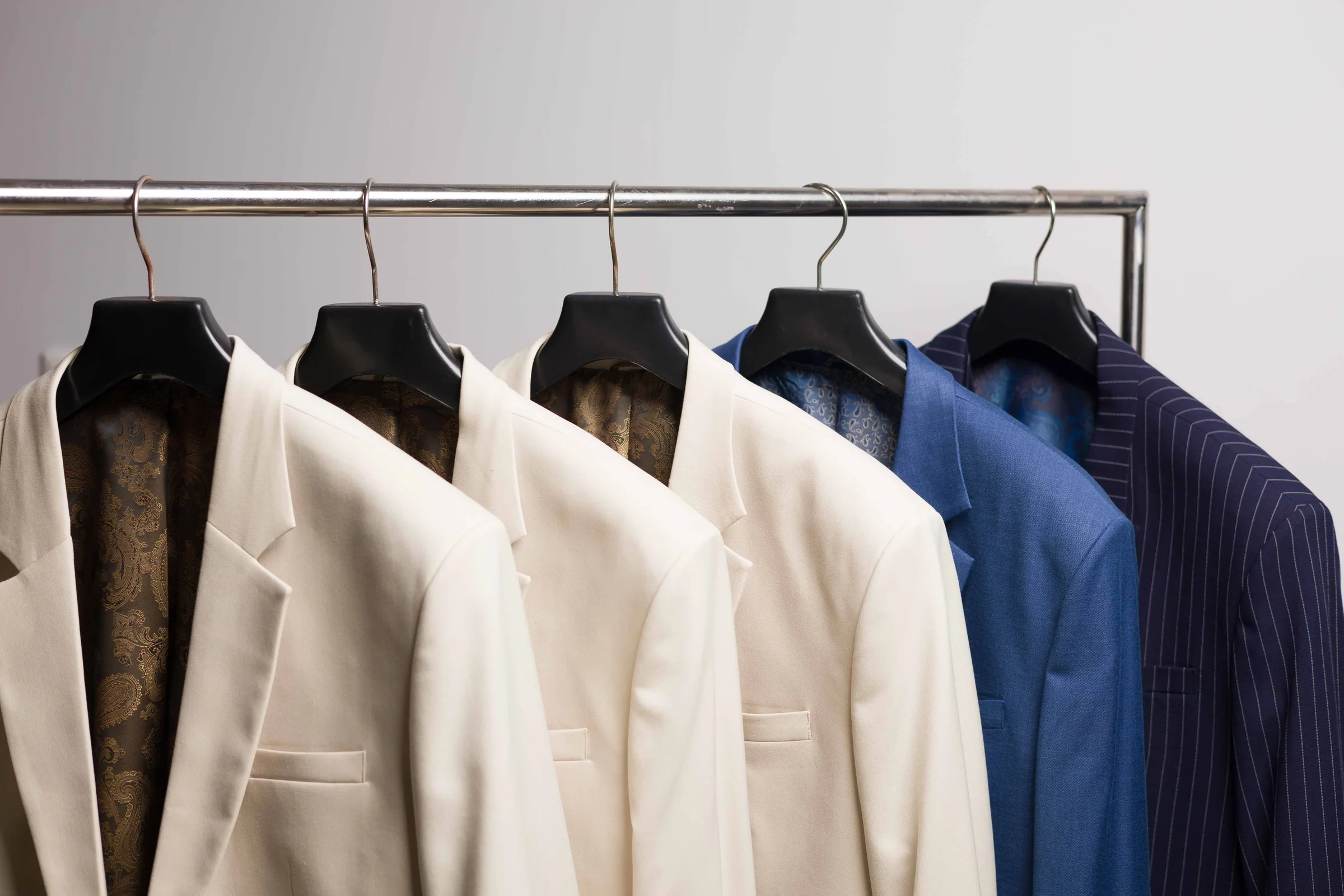
A suit colour guide sounds straightforward until you start asking the right questions. Not "what colour is popular?" but "what colour is correct for this situation, this wardrobe, and this body?" Those are different questions, and they deserve specific answers. This guide works through the main suit colours — navy, charcoal, grey, brown, and lighter warm tones — and explains where each one earns its place and where it falls short.
If you are working with our studio in Hội An on a first bespoke suit or a second, the colour decision should happen before the fabric decision. Get the colour wrong and no amount of fine cloth will save you. Get it right and even a modest fabric will carry the garment a long way.
Navy: The Most Versatile Starting Point
If someone can only own one suit, it should probably be navy. That is not a safe answer — it is simply true. Navy is formal enough for a job interview or a court appearance, relaxed enough for a summer wedding, and dark enough to read as professional in virtually any industry. It works with brown shoes and black shoes, with white shirts and pale blue ones, with patterned ties and plain.
The range within navy is worth knowing. A rich mid-navy reads as polished and contemporary. Very dark navy — approaching midnight — starts to compete with black and loses some of the warmth that makes navy useful. A brighter navy, almost royal blue, moves away from formality and into smart-casual territory, which has its place but is a different garment for different occasions.
Where navy struggles: against skin tones with strong blue or violet undertones, it can look flat. In those cases, a slightly warmer navy — one with just a trace of indigo — makes a real difference. This is exactly the kind of nuance a bespoke fitting should surface.
Charcoal and Mid-Grey: The Formal Workhorse
Charcoal is the most formally authoritative of all suit colours. It reads as serious without being as stark as black, which in most situations outside black tie is too blunt a choice. For court appearances, banking, law, or any context where gravitas is the primary requirement, charcoal earns its reputation.
Mid-grey is softer and more approachable — it photographs well, sits comfortably in a business context, and crosses into smart social occasions without difficulty. Where charcoal says "I am here to be taken seriously," mid-grey says "I am well-dressed and approachable." Both have their moments.
Grey suits tend to flatter a wide range of complexions because grey is neutral — it neither adds warmth nor coolness, which means it does not fight skin tone. The main risk is going too light on grey. A pale dove grey is a warm-weather suit, not an all-rounder, and it marks garments and shows wear quickly. Stay at mid-grey or above for a suit you plan to work hard.
If you are planning a second suit to complement a navy, charcoal is almost always the right call. Together, navy and charcoal cover the majority of professional and formal occasions without overlap.
Brown and Tan: Underused and Worth Reconsidering
Brown has an undeserved reputation in some circles as a lesser choice. The reality is that a well-cut mid-brown or tobacco suit is one of the more interesting things a man can wear — it has warmth, personality, and a distinctly European quality that navy and grey can lack. It pairs naturally with tan, cognac, and caramel shoes (always leather), and works especially well against olive, amber, and warm brown complexions.
Tan is a step further — lighter, more summery, and more situational. It reads well in daylight and outdoor contexts but can look washed out indoors under artificial light. For someone spending time in warm-climate settings or attending outdoor events, tan is worth having. It is not a suit for all seasons.
The convention that brown should not be worn in the City (the old British banking-district prohibition) has largely dissolved. The remaining real constraint is that brown works better in natural, daylight-heavy environments than in stark fluorescent offices. Know your setting.
Lighter Colours: Cream, Stone, and the Tropical Palette
Cream, ivory, stone, and pale linen tones occupy a specific and valuable corner of the suit wardrobe. They are warm-weather garments: weddings, tropical destinations, summer garden parties, outdoor lunches. They are not office suits or year-round suits, and trying to make them so is a mistake.
For visitors to Hội An commissioning suits in the heat of a Southeast Asian summer, cream or stone linen is one of the most practical and elegant choices available. The weight of the fabric, the colour's ability to deflect heat, and the relaxed formality all suit the context. This is where the tropical palette earns its keep — not transplanted to a grey October in London, but worn where it was always intended to be worn.
The challenge with lighter suits is maintenance. They show marks, require more frequent pressing, and need careful storage. If you are commissioning one, consider it a specific garment for specific occasions rather than an everyday workhorse.
Patterns: Stripes, Checks, and When to Use Them
Pattern in suiting does not change the colour logic — it adds a layer on top of it. A pinstripe suit in charcoal is still a charcoal suit; a windowpane check in mid-grey is still a grey suit. The base colour drives the occasion appropriateness; the pattern drives the personality.
Chalk stripes on dark grounds (navy or charcoal) are among the most classically formal patterns available — think City banking in the 1980s, but worn with more restraint today. They elongate the silhouette and carry authority.
Pinstripes on navy or dark grey are formal-to-business, slightly less weighty than chalk stripes. A fine pinstripe is a highly wearable office pattern.
Windowpane checks are smart-casual to business casual, depending on scale. A large windowpane on mid-grey reads as confident and contemporary. A smaller check on charcoal can work in more formal settings.
Glen plaid and houndstooth sit firmly in country and smart-casual territory. They are not office or formal patterns, but within their context they are excellent.
In terms of scale: finer patterns read as more formal; larger, bolder patterns read as more casual. A bold check is not wrong — it is just casual, and should be worn accordingly. For a first commission, we typically recommend plain cloth. Once you know how a suit should fit and feel, the pattern is the interesting conversation to have next.
How to Choose Based on Your Existing Wardrobe
The best suit colour is the one that creates the most new outfit combinations with what you already own. This is where a suit colour guide becomes personal rather than theoretical.
If your shirts are mostly white and pale blue, almost any dark suit colour works — navy, charcoal, and dark brown all complement them well. If you own richer shirts in burgundy, mustard, or rust, navy and brown are your natural suit partners; charcoal may fight those colours for attention.
Shoe colour matters too. If you own primarily black leather shoes, navy and charcoal serve you well and brown is harder to coordinate correctly. If you own cognac or tan shoes, navy still works beautifully, and brown suits become genuinely exciting rather than an experiment.
A useful exercise before commissioning: lay out your three or four most-worn shirts and your two pairs of shoes, and consider which suit colour connects them into the most useful combinations. That colour is usually your answer.
For more on what to commission and in what order, the complete guide to commissioning a bespoke suit covers the full decision process from cloth to construction. And if you are weighing up how many pieces your suit should have, the piece on two-piece versus three-piece suits works through that question in detail.
Frequently Asked Questions
What is the most versatile suit colour?
Navy is the most versatile suit colour for most men. It works across a wide range of formal and semi-formal occasions, pairs with both black and brown shoes, and suits the majority of complexions. If you own one suit, navy is almost always the correct choice. Charcoal is the second most versatile and is preferable if your primary context is formal business or professional settings.
Can you wear a brown suit to a wedding?
Yes, a brown suit is an entirely appropriate choice for a wedding — particularly a daytime or outdoor wedding. A mid-brown or tobacco suit in a fine wool or linen is elegant and distinctive without being flashy. Pair it with a cream or white shirt, a tie in warm tones, and tan or cognac leather shoes. Avoid very pale or very dark browns, and ensure the suit is well-tailored. A brown suit is a confident choice that reads better bespoke than off-the-rack, where the shading is often poorly managed.
Is navy or charcoal better for work?
It depends on the industry and the specific culture of your workplace. For most office environments, both are appropriate. Charcoal carries slightly more formal authority and is the stronger choice for client-facing roles in law, finance, or senior management. Navy is more approachable and works well in creative industries, consulting, and roles where you are meeting a range of people. When in doubt, charcoal in the morning for high-stakes meetings, navy in the afternoon for less formal ones — that is a useful framework if you have both.
Visit the Studio
Be Li Tailor is at 635 Hai Bà Trưng, Hội An Ancient Town, open daily from 8am to 9pm. Whether you're arriving next week or planning ahead, book your appointment online or reach us on WhatsApp at +84 905 820 116. We keep every client's measurements on file — if you've visited before, your next commission starts where the last one ended.